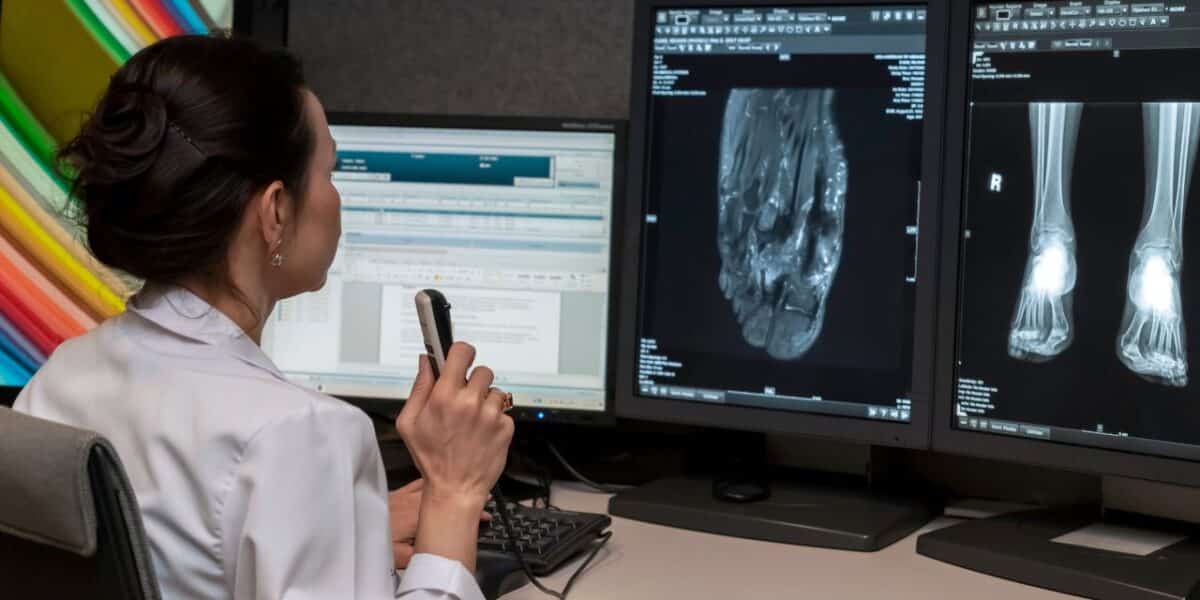
If you’re a physician, documentation is eating more than 2 hours of your day. More time charting than seeing patients. According to an AMIA survey, 77% of clinicians finish work later than desired or take patient notes home to complete documentation, and 74% say documentation workload directly impedes patient care. Researchers call it “pajama time”: the after-hours note-writing that eats into evenings and weekends. It’s a primary driver of clinician burnout, and manual note-taking under time pressure introduces errors into the chart.
The right medical dictation software cuts into that time. But the gap between products is real. Pick the wrong tool and you’ll spend just as long fixing transcripts as you would have spent typing.
We reviewed 8 apps across accuracy, HIPAA compliance, EHR integration, mobile support, and pricing. This guide gives you a clear recommendation for every practice type, from solo urgent care to enterprise health systems, and covers the healthcare productivity layer most dictation setups overlook.
AI scribe vs. traditional medical dictation: What’s the difference?
The distinction matters more than the marketing copy suggests.
Traditional medical dictation: you speak, the app converts your voice to text, you review and edit the transcript. Raw text output. You organize it into a note structure, fill in the EHR fields, and clean up errors. Faster than typing, but post-visit documentation work doesn’t disappear.
An AI scribe goes further. It listens to the clinical encounter as it happens and automatically generates a structured SOAP note from the conversation. The best ones push that note into your EHR with minimal editing required. Tradeoffs: AI scribes cost more, require more setup time, and sometimes need specialty-specific fine-tuning before accuracy is acceptable.
| Traditional dictation | AI scribe | |
|---|---|---|
| Speed | Fast voice input, manual editing required | Near-real-time note generation |
| Cost | $8–$100/user/month | $99–$500/user/month |
| Accuracy | High for speech recognition | Variable by specialty and accent |
| EHR integration | Copy-paste or direct input | Native EHR embedding at top tier |
| Setup time | Minutes | Days to weeks |
TextExpander lets you save standardized clinical phrases as reusable Snippets, cutting the post-dictation editing time that every dictation workflow leaves behind. See TextExpander for healthcare teams
What to look for in a medical dictation app
Not every voice-to-text tool qualifies as a medical dictation app. General-purpose voice apps fail clinical documentation because terminology is dense, abbreviations are non-standard, and transcription errors carry real consequences.
Accuracy with medical terminology is where most consumer tools fall short. Drug names, anatomical terms, dosing language: all require training on clinical vocabularies of 30,000+ medical terms, specialty-specific terminology, and common dosing language. An app that can’t reliably transcribe “oxycodone 5mg PO Q4-6H PRN” creates more work than it saves. This is one area where the right clinical documentation improvement software makes a measurable difference across a practice.
HIPAA compliance comes down to one document: the Business Associate Agreement. Any tool that processes protected health information (PHI) needs to offer a BAA before you go live. Look for end-to-end encryption of data in transit and at rest, and clear documentation of where patient data is stored and for how long. Never use Siri, Google Assistant, or Alexa for medical dictation. None of these assistants offer a BAA, and using them with PHI creates direct compliance exposure.
EHR integration is what separates a genuinely useful tool from an expensive transcription service. A native connector sends text directly into the correct EHR fields. Copy-paste workflows mean more manual steps after every encounter. Check compatibility with your specific system. Epic, Cerner, and athenahealth each have their own integration requirements, and not every app supports all three.
Mobile support matters for rounding, urgent care visits, and telemedicine calls that don’t happen at a desk. Some apps are desktop-first with thin mobile wrappers. Know which model fits your workflow before committing.
Two more things worth asking vendors about: specialty vocabulary coverage and total first-year cost. Radiology, pathology, cardiology, and surgical specialties need apps explicitly trained on those vocabularies. General-purpose tools underperform where terminology density is high. And AI scribe products often bundle implementation support into contract pricing that isn’t reflected in the per-seat rate. The subscription price is not the full cost.
Quick specialty reference:
| Specialty | Recommended tools | Why |
|---|---|---|
| Radiology / pathology | Dragon Medical One, Philips SpeechLive | Radiology-specific vocabularies; structured report formatting |
| Cardiology / oncology | DeepScribe, Dragon Medical One | Explicit specialty training on cardiovascular and oncology terminology |
| Emergency medicine | Tali AI, Freed AI | Mobile-first; fast setup for high-volume encounters |
| Primary care / family medicine | Freed AI, Dragon Medical One | Broad clinical vocabulary; strong SOAP note generation |
| Psychiatry / behavioral health | Any AI scribe + TextExpander | Standardized mental status exam language complements ambient scribing |
The 8 best medical dictation apps in 2026
1. Dragon Medical One
Dragon Medical One is the reference standard for medical speech recognition accuracy. If you’re evaluating tools for a large health system and need to justify the choice to IT and compliance, Dragon Medical One is the answer. Over 10,000 healthcare organizations use it globally, and the 99% accuracy on clinical vocabulary, with no per-user training period required, is what those numbers are built on.
The pricing reflects what it is. The 3-year contract runs $79/user/month, the 2-year $89, the 1-year $99. Solo practitioners won’t justify it. Workflow automation features also require additional licensing on top of the base subscription.
Key features:
- Native integration with Epic, Cerner, athenahealth, and 200+ other EHRs
- Desktop, browser, and mobile access via the Dragon Anywhere Mobile companion app
- HIPAA-compliant with BAA available
Accuracy holds across specialties, including dense-terminology fields like oncology and radiology. Broadest EHR integration coverage of any tool in this review. Physicians on Reddit consistently call it the gold standard for enterprise deployments.
Pricing: $79–$99/user/month depending on contract length
Best for: Enterprise health systems and large multispecialty groups that need proven accuracy and deep EHR integration
2. Freed AI
Freed AI is where most solo and small-group practitioners should start. Ambient listening during the encounter, automatic SOAP note generation, no structured voice commands required. Small-practice physicians and nurse practitioners on Reddit increasingly recommend it as their first pick for anyone leaving a hospital system for independent practice.
Key features:
- Ambient listening during the patient visit
- Auto-generates Subjective, Objective, Assessment, and Plan sections
- HIPAA-compliant with BAA
- Available on iOS and Android
- Vocabulary trained on 27,000+ medical terms
- Supports documentation in 90+ languages
What works well: minimal setup (active within minutes of account creation), SOAP note drafts ready within seconds of ending the encounter, and tiered pricing starting at $39/month.
What to know going in: Freed’s EHR integration is shallower than Dragon Medical One’s, and accuracy on specialty-specific terminology (cardiology, oncology) lags behind purpose-built tools. For primary care and family medicine, that rarely matters. For subspecialties, it might.
Pricing: Starter $39/mo (40 notes/month), Core $79/mo (unlimited notes + AI editing), Premier $119/mo (EHR push via Chrome extension, ICD-10/CPT codes)
Best for: Solo practitioners and small practices that want ambient AI scribe functionality without enterprise overhead
3. Dragon Copilot (formerly DAX Copilot)
Dragon Copilot is Microsoft’s ambient AI documentation platform: Dragon Medical One speech recognition combined with DAX ambient listening in a single product. It’s built for health systems already in the Microsoft ecosystem.
If your organization runs on Azure and has Epic embedded, Dragon Copilot is worth a serious evaluation. Health systems that have deployed it report meaningful cuts in documentation time, and the Microsoft-native deployment reduces IT overhead for organizations already on Azure.
For everyone outside the Microsoft stack: the implementation complexity and estimated pricing of $370–$600+/user/month based on deployment size make the ROI difficult to justify. This is not a self-serve product.
Key features:
- Ambient AI listening with automatic note generation
- Deep Epic integration with embedded in-visit documentation
- Powered by Microsoft’s HIPAA-eligible infrastructure
- Pairs with Dragon Medical One licensing for organizations already using DMO
Pricing: Enterprise contract pricing; estimated $370–$600+/user/month based on deployment size (contact Microsoft for a quote, checked April 2026)
Best for: Large health systems on the Microsoft stack that need ambient AI at enterprise scale
4. DeepScribe
DeepScribe is the tool for specialty groups that need documentation and coding handled together. Most AI scribes stop at SOAP note generation. DeepScribe adds AI-assisted medical coding: E/M, HCC, and ICD-10. This matters for organizations where revenue cycle and clinical documentation are managed in parallel.
Specialty vocabulary depth is also the strongest among the AI scribes reviewed here, trained on 10+ specialties including oncology, orthopedics, and urology.
At $300–$500/user/month, it’s priced for multispecialty groups and academic medical centers. Solo and small-group practices have better options at a fraction of the cost.
Key features:
- Specialty-specific AI trained on 10+ specialties including oncology, orthopedics, and urology
- Automated SOAP note generation from ambient listening
- AI-assisted medical coding (E/M, HCC, ICD-10)
- EHR integration via API and direct embedding
Pricing: $300–$500/user/month
Best for: Multispecialty groups and academic medical centers that need specialty-specific accuracy and AI coding support
5. Amazon Transcribe Medical
Amazon Transcribe Medical is an API, not an app. It’s built for health tech teams building custom transcription pipelines inside their own products or EHR systems. Individual clinicians looking for a turn-key solution should stop here and look elsewhere.
For health tech developers: $0.075/minute, HIPAA-eligible under the AWS BAA framework, with specialty vocabulary support across primary care, cardiology, neurology, oncology, and radiology. Real-time streaming via WebSocket API, no per-user seat fees. You pay only for the audio you transcribe. At scale, nothing else in this category comes close on economics.
Key features:
- HIPAA-eligible under the AWS BAA framework
- Supports medical specialty vocabularies: primary care, cardiology, neurology, oncology, and radiology
- Real-time and batch transcription modes
- Streaming transcription via WebSocket API
Pricing: $0.075/minute for medical transcription
Best for: Health tech companies and large health systems building custom documentation workflows on AWS infrastructure
6. Tali AI
Tali AI is built for how most emergency, telemedicine, and hospital medicine clinicians actually work: on a phone, between patients. Native iOS and Android apps, polished and fast, with ambient listening that holds up in the noisy, interrupted environments where other tools struggle.
Free tier is functional for low-volume use. Paid plan runs approximately $100/month billed annually. EHR integrations are limited compared to Dragon Medical One or Dragon Copilot. For anyone spending most of their time at a desktop workstation, Freed AI or Dragon Medical One will fit better.
Key features:
- Native iOS and Android apps with ambient listening
- SOAP note generation from voice
- HIPAA-compliant with BAA
- Free tier available for low-volume users
Pricing: Free tier available (limited monthly usage). Paid plan approximately $100/month (billed annually).
Best for: Mobile-first clinicians, telemedicine providers, and urgent care physicians who need a polished phone-based AI scribe
7. Notta
Notta started as a general transcription tool and added a medical mode later. It shows. Accuracy on dense clinical terminology lags behind every purpose-built tool in this review. No EHR integration. BAA availability requires verification before using the free tier with PHI. Confirm this before deploying in a clinical setting.
The case for Notta: $8.25/month billed annually is the lowest paid price in this category by a wide margin. For a solo practitioner dictating straightforward primary care notes with no EHR integration requirements, it’s a workable starting point.
Key features:
- Medical transcription mode with clinical vocabulary support
- Available on iOS, Android, Mac, Windows, and browser
- Supports 50+ languages
- Automatic summary and keyword extraction
Pricing: Free tier available. Pro plan: $8.25/month (billed annually) or $13.99/month (billed monthly).
Best for: Budget-conscious solo practitioners who need basic transcription for low-complexity notes
8. Philips SpeechLive
Philips SpeechLive is the only product in this list where the starting point is hardware, not software. Philips Speech has been making dictation recorders for decades, and SpeechLive is the hosted transcription service that connects those devices to a workflow. If your practice already runs on Philips dictation hardware, SpeechLive is the natural extension. Starting fresh without existing Philips equipment? The other options here offer more competitive software experiences.
Key features:
- Hosted dictation with automated and human transcription options
- Integration with Philips SpeechMike and other Philips dictation hardware
- HIPAA-compliant with BAA available
- Workflow management for transcription teams and medical typists
Pros:
- Purpose-built for practices already running Philips dictation hardware
- Combines automated speech recognition with a human review option for sensitive workflows
- Enterprise-grade audio quality via Philips microphone hardware
Cons:
- Less competitive as a standalone software choice versus AI scribe alternatives
- Enterprise pricing requires a direct quote from Philips
- UI is less modern than purpose-built AI scribe tools
Pricing: Enterprise pricing (contact Philips for a quote)
Best for: Practices with existing Philips dictation infrastructure that want a connected hosted transcription workflow
Best medical dictation app for iPhone and Android
Most clinical documentation doesn’t happen at a desk. Rounding, urgent care encounters, telemedicine visits, and point-of-care notes all happen on a phone or tablet, which makes mobile performance a first-tier evaluation criterion, not an afterthought.
Top iOS picks:
- Freed AI: Best overall AI scribe on iPhone. The iOS app delivers the same ambient listening and SOAP note generation as the desktop version, with an interface optimized for quick documentation after each encounter.
- Tali AI: Built mobile-first with a native iPhone app. Best option for clinicians who document exclusively on a phone and need a fast, polished interface.
- Dragon Medical One via Dragon Anywhere Mobile: For Dragon Medical One users who need desktop-grade accuracy on iPhone. The companion app connects to the same voice profile and vocabulary library used on desktop.
Top Android picks:
All three top iOS picks also lead on Android. Freed AI and Tali AI both offer full-featured Android apps with feature parity to iOS. Dragon Anywhere Mobile is available on Android as well, maintaining the same vocabulary and accuracy profile as the desktop version.
HIPAA warning: Never use Siri, Google Assistant, or Alexa for medical dictation. None of these assistants offer a Business Associate Agreement, and using them to process protected health information creates direct HIPAA compliance exposure. Stick to purpose-built medical dictation apps for all clinical documentation.
TextExpander works on iPhone, iPad, Mac, and Windows, so your clinical phrase library travels with you wherever you document. See TextExpander for healthcare teams
Medical dictation app comparison table
| App | HIPAA BAA | EHR integration | iOS | Android | Offline mode | AI scribe | Starting price |
|---|---|---|---|---|---|---|---|
| Dragon Medical One | Yes | Yes (200+ EHRs) | Yes | Yes | No | No | $99/user/mo |
| Freed AI | Yes | Partial | Yes | Yes | No | Yes | $39/mo |
| Dragon Copilot | Yes | Yes (Epic native) | Yes | Yes | No | Yes | ~$370/user/mo |
| DeepScribe | Yes | Yes | Yes | Yes | No | Yes | $300/user/mo |
| Amazon Transcribe Medical | Yes (AWS BAA) | No (API only) | No | No | No | No | $0.075/min |
| Tali AI | Yes | Limited | Yes | Yes | No | Yes | Free / ~$100/mo |
| Notta | Verify before use | No | Yes | Yes | No | No | Free / $8.25/mo |
| Philips SpeechLive | Yes | Limited | Yes | Yes | No | No | Enterprise |
AI scribes cluster at the high end of the pricing range, from $39 to $600+/user/month. Tali AI and Notta are the only tools with free tiers. Dragon Medical One and Dragon Copilot are the only tools with deep native EHR integration out of the box.
Which medical dictation app fits your practice size?
| Practice type | Best fit | Starting price |
|---|---|---|
| Solo practitioner | Freed AI or Tali AI (free tier) | Free–$39/mo |
| Small group (2–10 providers) | Freed AI or Dragon Medical One | $39+/mo |
| Multispecialty group | DeepScribe or Dragon Medical One | $99–$300/user/mo |
| Large health system | Dragon Copilot or Dragon Medical One | $99–$600+/user/mo |
| Health tech / custom build | Amazon Transcribe Medical | $0.075/min |
Solo and small-group practices rarely need the deep EHR automation that justifies enterprise pricing. Start with Freed AI or Tali AI, validate the workflow, and upgrade to Dragon Medical One or Dragon Copilot when patient volume and EHR integration requirements demand it.
How dictation output maps to SOAP notes
Here’s something most tool comparisons skip: what actually happens between the dictation output and the final note in your chart.
Every clinical note follows the same fundamental structure. Understanding how dictation tools populate that structure helps you pick the right tool for your documentation style.
The four SOAP sections:
- Subjective: What the patient reports, including symptoms, history, chief complaint, and pain level
- Objective: What you observe or measure, including vitals, physical exam findings, and lab values
- Assessment: Your clinical interpretation of the diagnosis, differential, and reasoning
- Plan: What happens next: medications, referrals, orders, follow-up
Traditional dictation tools capture whatever you say and return raw text. You organize it into SOAP sections, which shifts the documentation burden from typing to editing and reorganizing. AI scribes handle the structuring automatically. Ambient listening captures the full encounter, and the AI maps the conversation onto the SOAP framework, populating each section from the natural flow of the visit.
Here’s the workflow gap both approaches leave: standardized phrases. Even after dictation captures the clinical encounter and an AI scribe structures the note, clinicians still write medication instruction language, chief complaint boilerplate, discharge summary templates, and referral language from scratch. These phrases don’t need dictation. They’re the same every time. Retyping them after every encounter wastes time that neither dictation nor AI scribing addresses.
Specialty-specific SOAP variants add another layer of complexity. Psychiatry notes include mental status examinations with consistent clinical language. Pediatric notes follow age-based developmental assessment formats. Chiropractic and dental notes follow their own structural conventions. Standardizing these phrases across a practice requires more than dictation alone.
Read more on how to write medical progress notes faster, or browse SOAP note templates to give your team a consistent starting point for every encounter type.
How TextExpander complements your dictation workflow
There are two kinds of clinical documentation: the things that are unique to each encounter, and the things that are identical every time.
Dictation and AI scribing handle the first category well. The second category covers medication instruction blocks, chief complaint boilerplate, discharge instruction paragraphs, prior authorization language, referral boilerplate, and follow-up messaging. These phrases are predictable, standardized, and repetitive. TextExpander is built for exactly this.
The combined workflow: dictate the clinical encounter to capture the unique visit details, then expand standard Snippets for Assessment and Plan language to fill in the EHR in seconds. What took 10 minutes now takes 2.
TextExpander works inside every EHR via keyboard input. No PHI is stored in Snippets, which keeps the workflow HIPAA-safe. Snippet Groups can be organized by specialty: a cardiology Group handles procedure notes and medication titration language, a primary care Group handles preventive care templates, and a psychiatry Group covers mental status exam boilerplate.
The team library feature means updates propagate instantly across every provider’s device. When a formulary changes or discharge instructions get updated, the Group Admin updates a single Snippet and every clinician gets the new language immediately. No email threads. No version drift.
For healthcare productivity gains that compound over time, this is the workflow layer most dictation setups are missing. See how TextExpander for healthcare teams fits into your documentation workflow.
Try TextExpander free for 30 days and build your clinical phrase library today. Start your free trial
Frequently asked questions
What is the best medical dictation app for doctors?
The best medical dictation app depends on your practice size and workflow. Dragon Medical One is the top choice for enterprise health systems that need proven accuracy and deep EHR integration. Freed AI leads for solo and small-group practices that want ambient AI scribe functionality without an enterprise contract. Tali AI is the strongest option for mobile-first clinicians and telemedicine providers. Match the tool to your workflow rather than defaulting to the most recognized name.
Is Dragon Medical One worth it?
For large practices on Epic or Cerner, Dragon Medical One delivers industry-leading accuracy, deep EHR integration, and proven ROI at scale. The $79–$99/user/month pricing reflects a professional-grade product that performs reliably in high-volume clinical environments. Smaller practices typically get better value from Freed AI or Notta at a fraction of the cost, since the enterprise EHR integration features that justify Dragon Medical One’s pricing go unused at lower patient volumes.
Are medical dictation apps HIPAA compliant?
Purpose-built medical dictation apps, including Dragon Medical One, Freed AI, and Dragon Copilot, all offer Business Associate Agreements and meet HIPAA requirements for clinical use. General consumer voice assistants (Siri, Google Assistant, and Alexa) do not offer BAAs and are not appropriate for clinical dictation involving PHI. Always request and sign a BAA before deploying any dictation tool in a clinical setting. You can review TextExpander’s HIPAA compliance for reference on what a healthcare-ready agreement looks like.
What is the best free medical dictation app?
Tali AI and Notta both offer free tiers with limited monthly minutes. For reliable clinical accuracy and EHR workflow integration, free tiers are too restricted for daily use. Plan on $8–$100/month for a paid plan that handles a full day of patient encounters without hitting minute caps.
What’s the difference between a medical dictation app and an AI scribe?
A dictation app converts your voice to text. You organize and edit the note afterward. An AI scribe listens to the clinical encounter as it happens and automatically generates a structured SOAP note with minimal editing required. AI scribes cost more, but a large multi-site study published in JAMA in April 2026 found average documentation time reductions of around 16 minutes per session, which matters more at high patient volume than in low-volume practices.
Conclusion
No single app wins for every practice. That’s not a hedge. The right choice genuinely depends on your EHR, specialty, team size, and tolerance for post-visit editing.
Honest recommendation: start with Freed AI or Tali AI, run it against a real documentation day, and upgrade only if EHR integration gaps or specialty vocabulary limitations become a problem. Most solo and small-group practices don’t need Dragon Copilot’s price point to cut documentation time.
Whatever you pick, pair it with a text expansion layer. Dictation captures the unique parts of each encounter. The standardized parts are the same every time: medication language, discharge instructions, referral boilerplate. Dictation doesn’t touch those. Browse our medical productivity apps guide, then start your free TextExpander trial and build your clinical phrase library today.
Try TextExpander free and start building your clinical phrase library today. Start your free trial