
Uncertainty is the word that comes to mind for many healthcare providers, patients, and practices on the state of the industry since COVID-19 began. Some impacts of the global pandemic are positive, like the increased availability of more inclusive forms of telehealth and innovations in technology to improve patient care. Others, like hospital systems’ reimbursement rate gaps, cost inflation, and staffing shortages, outline significant challenges in the industry.
Jump to a section :
- Part 2: Mitigating Staffing Shortages
- Part 3: Managing Surge Capacity
- Part 4: AI and Your Practice
- Part 5: Establishing Equitable Care
Despite these challenges, there are many signs that the healthcare industry will continue to grow in both profitability and demand.
Future demand for practitioners and services
Burnout-driven resignations and the growing costs of maintaining staff have led to staffing shortages across the healthcare industry.
According to the JAMA Network, healthcare providers were overwhelmed and burned out in the wake of the global pandemic. There is a risk that this burnout can continue to exacerbate staffing shortages. A study of 18 million healthcare workers found that job exits in early 2020 were primarily from workers exiting to nonemployment. By late 2021, exits were primarily from workers exiting to take jobs in other sectors.
If not addressed, staffing shortages will continue to strain the U.S. healthcare system. A report by Deloitte found that the demand for healthcare workers is expected to surge by 29% in the next decade. Meanwhile, the Association of American Medical Colleges projected a shortage of between 54,100 and 139,000 physicians by 2033.
The Association of American Medical Colleges projected a shortage of between 54,100 and 139,000 physicians by 2033.
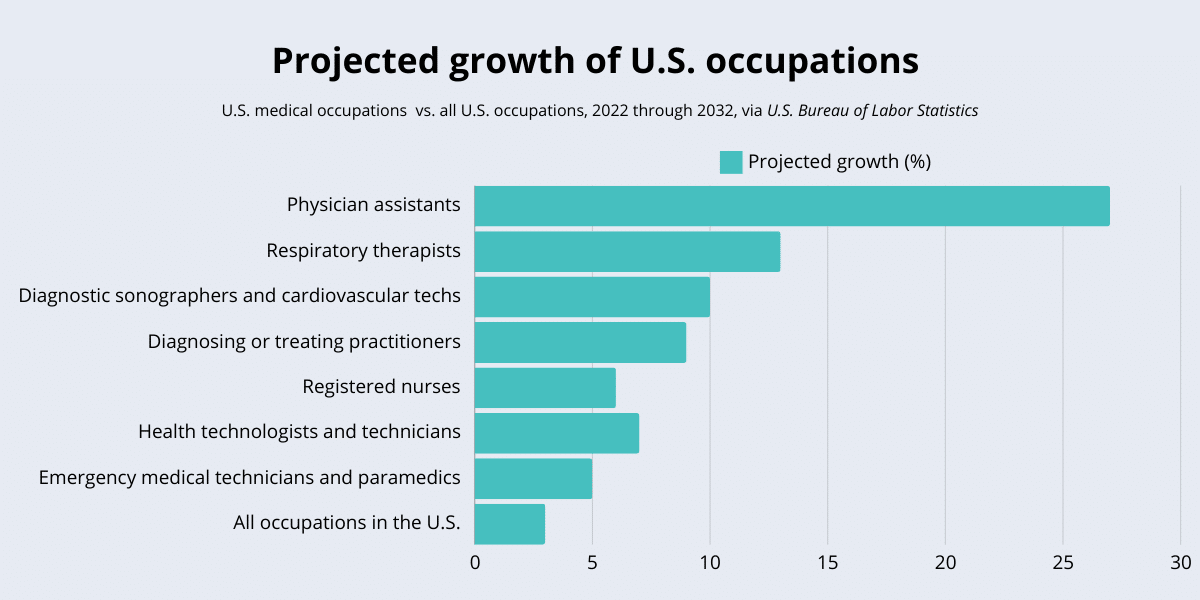
Additional data from the U.S. Bureau of Labor Statistics breaks down how different medical roles are projected to grow between 2022 and 2032 compared to other occupations in the U.S. Overall, the growth in demand for medical roles far outpaces the average U.S. job growth.
Up next?
In a world where we can get groceries delivered in one hour and connect face-to-face with colleagues around the globe, more and more patients are expecting the same technological advancements from their healthcare providers. Balancing compliance, patient satisfaction, and effective care means balancing how you bring technology into your practice or organization.
We’ve gathered insights from 13 medical leaders and healthcare providers about scaling your practice or healthcare company without compromising patient care.
In this five-part series, we’ll bring you lessons, tips, and insights from our medical leaders who have proven success in growing their healthcare practices across mental health, primary care, obstetrics and gynecology (OB-GYN), pediatric care, nursing, pain management, audiology, and addiction counseling.
As articles are published, we’ll link them here. You can expect to learn more about:
- Mitigating Staffing Shortages: Tactics from leaders in healthcare on how they are preparing for a growing staffing gap and supporting their teams in the process.
- Managing Surge Capacity: When your practice is dealing with a sudden influx of patients or requests, having the right tools and technology can ensure a compliant practice and happy patients.
- AI and Your Practice: Is AI the solution healthcare professionals and patients are looking for? Our experts discuss the pros and cons, plus how to prepare for the new era of technology in the medical industry.
- Establishing Equitable Care: Our medical leaders agree: When you create equitable paths to care for all patients, your practice can truly scale.
TextExpander is free. Your time isn’t.
Create shortcuts for the things you type most and start saving time everywhere you type. Use it solo or build a shared library with your team.
Free forever, no credit card required.