
B2B buyers are spending less time with sellers. In a Gartner survey of 646 B2B buyers, 67% said they prefer a rep-free experience, and 45% said they used AI during a recent purchase.
Sales reps still matter, but at different points in the deal: buyers do more of the research on their own, then lean on a rep when they need to make a confident decision.
The six sales trends below follow from that shift, from how relationships are built to how teams use AI without losing the human judgment that closes deals.
Key takeaways
- Buyers now complete more of the buying process without a sales rep, so the conversations that remain carry more weight. Reps who show up prepared and specific help buyers feel confident about a decision they have mostly researched on their own.
- Personalization works best when it starts from accurate CRM records and approved language. Reps can personalize faster when the stable parts of a message are saved and only the prospect-specific details change.
- AI is now part of the everyday sales process, but adoption alone does not improve sales performance. Most teams now use some form of AI, while far fewer organizations report measurable financial impact, which makes data quality and human review central to getting value from it.
- Trend analysis is most useful when leaders apply it to their own pipeline. Comparing published sales trends with historical data on win rate, sales cycle length, and lead sources shows which changes deserve a response this year.
Some of these top sales trends started years ago and have matured. Others, like AI-assisted selling, have moved quickly. Each section covers what is happening and what it means for how your team sells.
1. Relationship building
For years, the internet, email, and social media pushed sales toward volume: generic emails sent to large lists and ads aimed at broad audiences. Customers pushed back. They want to be treated as people with specific priorities, and that demand has brought sales back to a more traditional focus on strong one-to-one relationships, supported by modern tools.
The way buyers choose vendors has made those relationships more selective. Many prefer to research products, compare prices, and read reviews before speaking to anyone, so a sales rep often enters the buying journey late. The same Gartner research found that confident buyers are twice as likely to report a high-quality deal. When a buyer does reach out, the rep’s job is to answer the questions that research could not, reduce risk, and help the buyer feel sure about the choice.
In practice, that means:
- Responding quickly with answers that reflect what the buyer has already learned
- Bringing a good understanding of the buyer’s industry and constraints to every call
- Sending specific next steps after each conversation, not generic check-ins
- Staying in touch after the sale, since customer experience shapes renewals and referrals
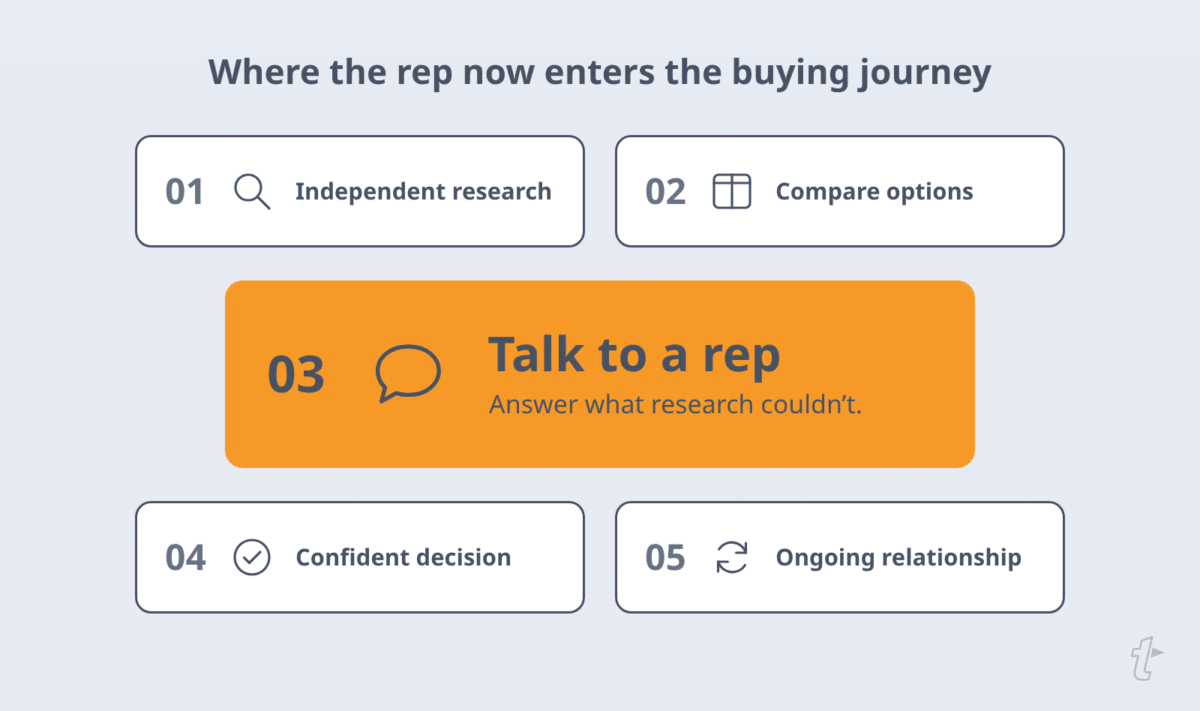
When buyers can compare vendors on their own, the relationship is often what keeps an account. Teams that focus on the lifetime value of each customer can justify the time that real relationships take. For more on earning that trust, see the importance of trust in sales.
2. Personalization
Buyers who arrive informed expect a rep to reflect their situation, not repeat the website. Personalization now depends heavily on sales data: CRM records, website activity, past conversations, and product usage tell reps what a prospect cares about before the first message. AI-powered research tools can summarize that information and suggest outreach angles, reducing the time spent researching each account.
The limit is data quality. In Salesforce’s State of Sales report, a survey of 4,050 sales professionals in 22 countries, 79% of top performers said they prioritize data hygiene, compared with 54% of underperformers. Salesforce sells AI and CRM software, so read its findings as one vendor’s view of the market. The gap still points to a simple rule: personalization built on outdated records sends the wrong message to the right person.
Practical personalization usually combines two layers:
- The stable layer: approved product descriptions, pricing explanations, and answers to common objections that should stay consistent across the team.
- The personal layer: the prospect’s name, company, goals, and the specific problem they described.
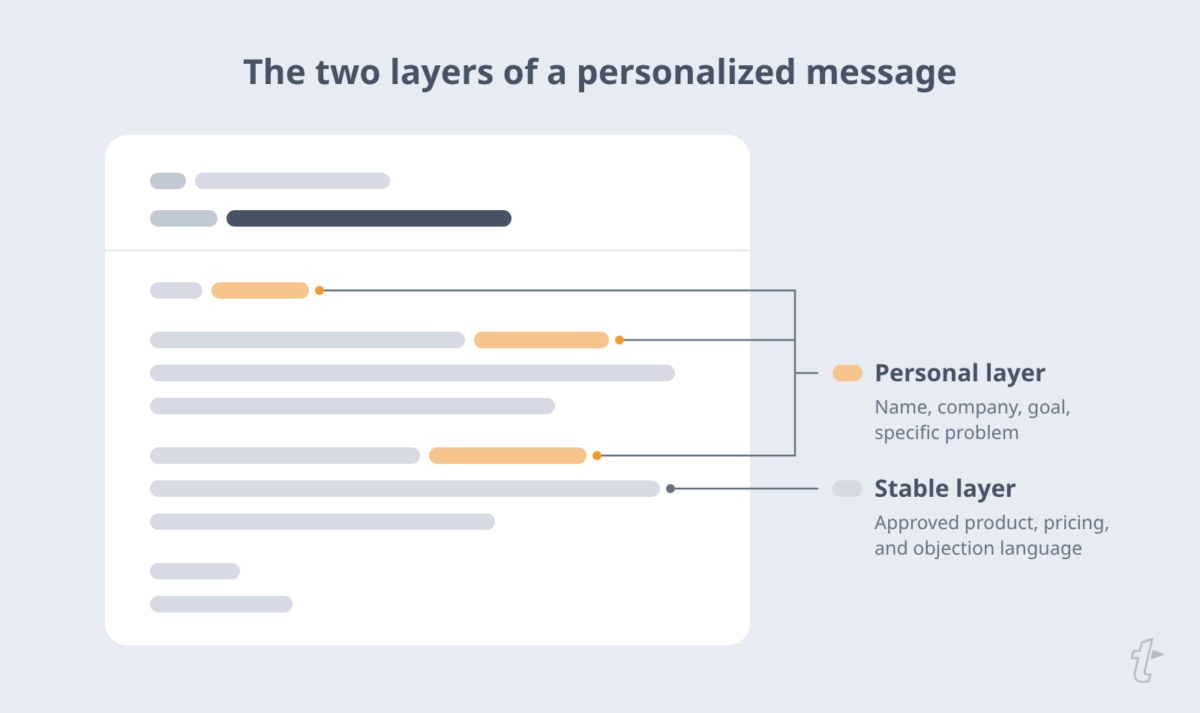
Keeping the stable layer saved and ready lets reps focus on the personal layer. A shared library of follow-up messages with fill-in fields, for example, lets a rep insert the approved structure and then add the details that make it relevant to one buyer.
As an Account Executive in enterprise sales, I send a high volume of personalized outreach, follow-ups, and internal communications every day. TextExpander lets me store and instantly deploy my best-performing messaging without sacrificing the ability to customize on the fly.
Johnny Fan, Account Executive, LinkedIn
3. Attention on social media
Social platforms continue to capture a large share of daily attention, and sales has followed. Social selling, which means using professional networks to research prospects, share useful insight, and start conversations, has become a standard part of the sales toolbox, especially in B2B.
Social selling works because it meets potential buyers where they already spend time and lets reps build credibility before asking for a meeting. A thoughtful comment on a prospect’s post or a useful article shared with a short note often lands better than cold outreach, as long as it is specific and not promotional.

Generational change is reinforcing the trend. Gen Z professionals are moving into buying roles and onto sales floors, and they are used to researching through social channels and online communities.
Salesforce’s survey also found that Gen Z reps spend about 35% of their time selling, compared with 40% for sellers overall, and lose about two hours a week to manual data entry. For sales leaders, that is a reminder that the newest reps need fewer administrative tasks and more support for the parts of the job that build relationships.
4. Integration and collaboration with marketing
Many businesses still run separate marketing and sales departments, but the line between them keeps blurring. That gray area has caused friction over the years, especially over who owns which part of the sales and marketing process. A more useful approach is to treat lead generation, nurturing, and closing as one shared system with common goals.
Closer alignment pays off in several ways:
- Marketing teams share what they learn about customer behavior from campaigns, content, and website activity.
- Reps share the questions and objections they hear on calls, which improves marketing strategies and content.
- Both teams work from the same definition of a qualified lead and the same view of the sales pipeline.
- Messaging stays consistent from the first ad a buyer sees to the last email before a contract is signed.
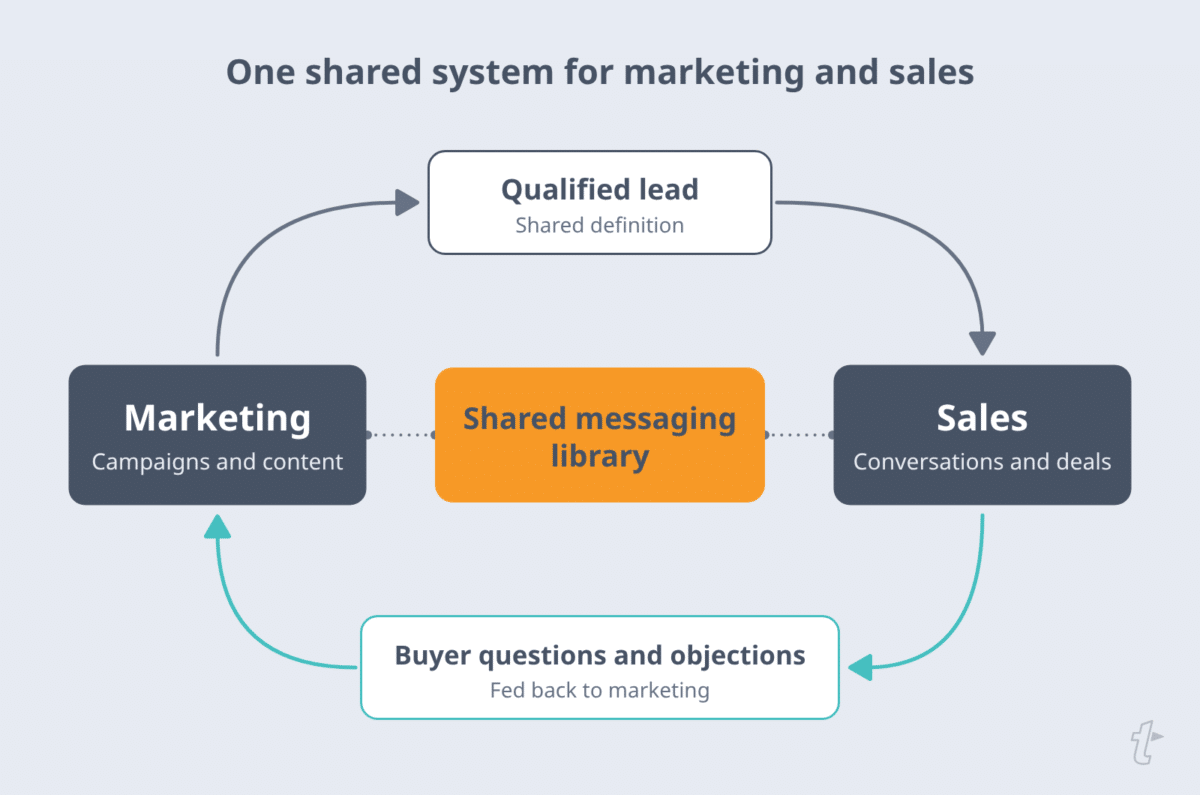
Personalization makes that consistency more important. A well-targeted marketing email and a sales email can look almost identical to a buyer, so the two teams need to describe the product the same way. Many organizations keep shared messaging in one place so both teams can use the current version. For a deeper look at how the two functions support each other, read the symbiotic relationship between sales and marketing.
5. Remote selling
Remote selling began in response to limits on travel and in-person meetings and is now a standard part of how many teams sell. Video calls, digital proposals, e-signatures, and messaging tools let reps run most of the sales cycle from a desk.
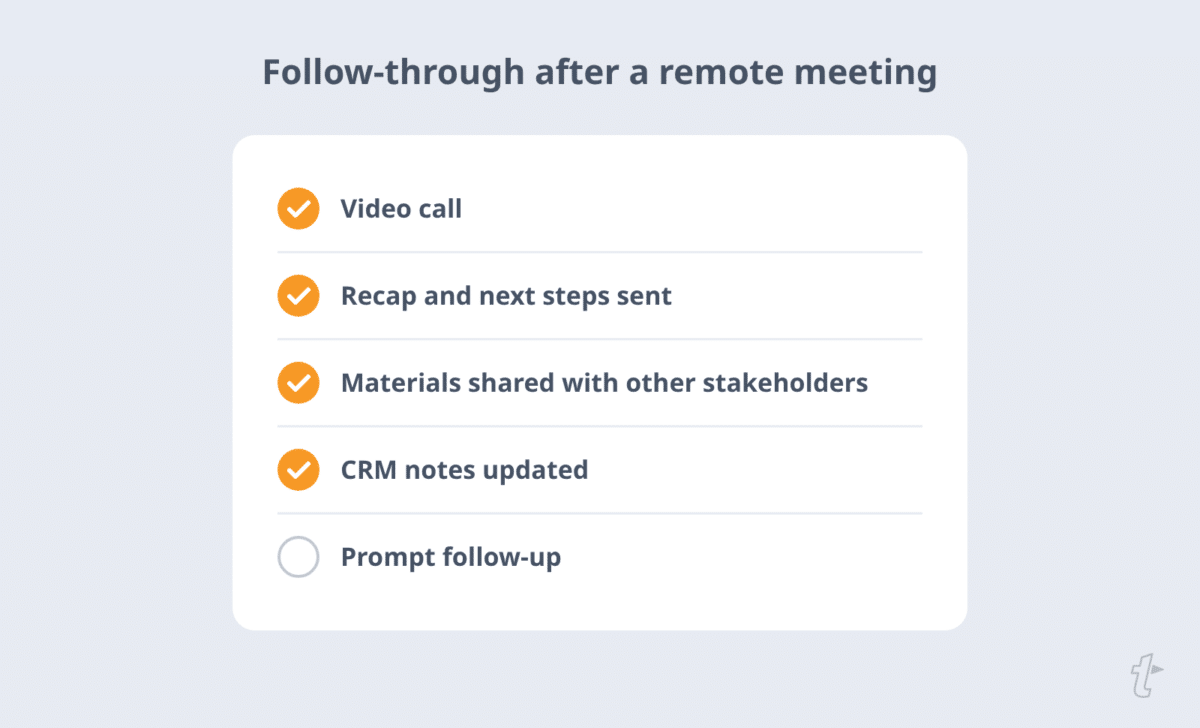
Digital selling changes the rhythm of a deal. Buying cycles can move faster when meetings are easy to schedule, or stall when buyers go quiet between video calls. Reps need tighter habits around:
- Sending clear recaps and next steps after every meeting
- Sharing materials that buyers can circulate to colleagues who were not on the call
- Keeping CRM notes current so anyone on the team can pick up the account
- Following up promptly without repeating the same generic message, since consistent follow-through is part of winning deals
Much of that work means writing the same kinds of messages again and again. Teams that save their best recap and proposal language can respond faster while still tailoring each message. Our guide to the three components of a strong sales follow-up email covers what each message should include.
6. How sales teams use AI in 2026
Of all the sales trends on this list, AI has moved fastest, from experiment to everyday sales technology. Salesforce’s State of Sales survey found that 87% of sales organizations use some form of AI, and 54% of sellers say they have used AI agents. That matches the wider workforce: Gallup found that 52% of U.S. workers use AI in their role, with writing and editing as the top use.
Where reps put AI to work
Most teams start with the tasks that take the most time and the least judgment:
- Prospect research: summarizing a company’s news, filings, and website before a first call.
- Outreach drafts: writing first versions of prospecting emails and follow-ups. Salesforce’s respondents expect AI agents to cut prospect research time by 34% and email drafting time by 36%.
- Call preparation and recaps: generating questions before a meeting and summaries after it.
- Cold calling and outreach volume: nearly half of reps in the same survey called cold calling the worst part of their job, and 48% said they lack the bandwidth for adequate cold outreach. AI agents that qualify inbound leads or handle early outreach give reps more time for conversations with interested buyers.
Our list of ChatGPT prompts for sales shows how reps apply this at each deal stage.
Why adoption is not the same as results
Adopting AI and getting value from it are two different milestones. McKinsey’s State of AI 2026 found that nearly nine in ten organizations regularly use AI in at least one business function, but only 37% of respondents attribute any EBIT impact to it. Accuracy is part of the gap. In a University of Melbourne and KPMG study covering 47 countries, 66% of employees surveyed said they rely on AI output without evaluating its accuracy, and 56% said they had made mistakes in their work because of AI.
In sales, those mistakes show up as a wrong price, an outdated feature claim, or a message that sounds nothing like your company. The Melbourne and KPMG findings show that people often accept AI output without checking it, so review and reliable source material matter as much as the tool itself.
Keeping AI-assisted selling accurate and on message
Sales teams that get the most from AI usually put a few guardrails in place:
- Standardize the prompts that work. When one rep finds a prompt that produces a strong account summary, save it so the whole team can use it.
- Give AI source material that’s been approved. Product descriptions, pricing language, and objection responses should come from a current, approved version.
- Keep a person in the loop. Reps should review every AI draft before it reaches a buyer, especially any that involve pricing, contracts, or commitments.
- Clean the data first. In Salesforce’s survey, 51% of sales leaders with AI said disconnected systems are slowing their AI initiatives.
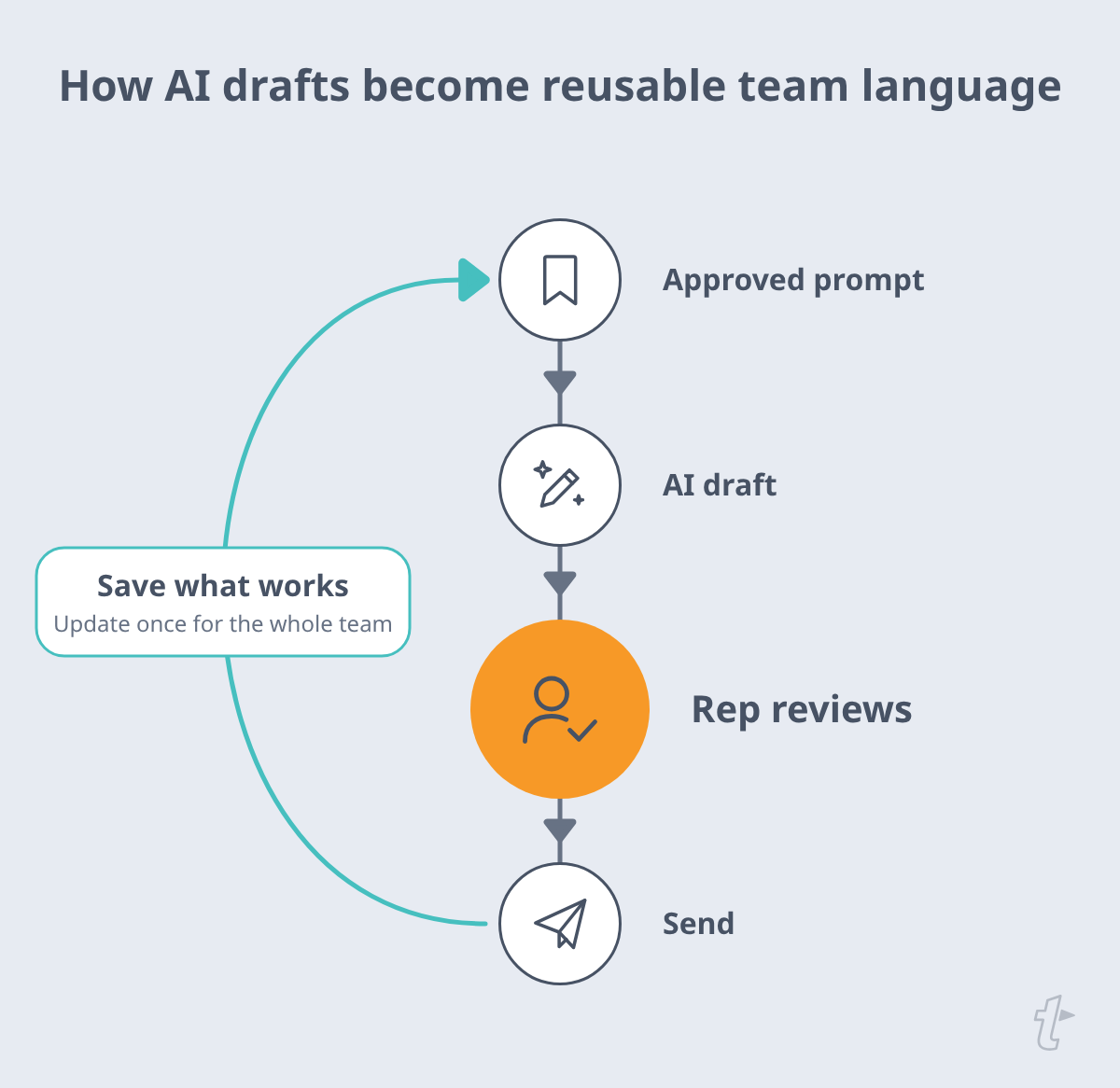
This is where generation and reuse work together. AI is useful when a message needs to be written from scratch. Saved, approved language is useful when the team already knows what good looks like.
With TextExpander, teams can keep their best prompts, message templates, and product answers in shared Snippets, so every rep starts from the same current language in email, the CRM, LinkedIn, or an AI tool. Learn more about using an AI text expander for prompts and drafts.
How to turn sales trend analysis into a plan
Industry trends are only useful if you know which ones affect your own sales performance. A short review of your own numbers shows where to act first, and these steps work for most sales teams:
- Pull 12 to 24 months of historical data. Look at win rate, average sales cycle length, deal size, and lead sources by quarter. Your CRM usually holds everything you need.
- Compare your numbers with the trends above. If your sales cycle is getting longer while buyers say they prefer to research on their own, prospects may be stalling because they cannot find the answers they need without a call.
- Choose a small set of performance metrics to watch. Win rate, pipeline coverage, response time to inbound leads, and time spent selling give a clear view of sales success without burying the team in dashboards. Our guide to key sales metrics every team should track covers how to define each one.
- Account for market conditions. Budget freezes, pricing changes, and new competitors affect buying cycles. Separate those effects from changes in your own sales process before drawing conclusions.
- Test one change at a time. Before rolling out any change meant to increase sales, pilot it with part of the team. If you add AI-assisted outreach or a new email sequence, measure its effect on win rate and cycle length before expanding it.
Repeating this review every quarter keeps your sales strategy grounded in what your buyers are doing, not only in what industry reports predict. It also surfaces new opportunities, such as a lead source that is converting faster than expected. To measure the overall result, learn how to calculate your company’s sales growth rate.
What these sales trends mean for your team
Selling in 2026 rewards teams that combine better information with better conversations. Buyers arrive informed, AI handles more of the research and first drafts, and reps spend their time where judgment matters most. The fundamentals of selling remain the same: understand the buyer, answer honestly, and follow through.
The practical step for most teams is to make their best knowledge easier to use. When recaps, product answers, and proven prompts are saved and shared, reps spend less time recreating messages and more time with buyers. A practical place to start is the messages your reps send most often. To stay ahead of these sales trends, try TextExpander free and build your team’s first shared library.
Frequently Asked Questions
The biggest sales trend in 2026 is the combination of AI-assisted selling and buyers who prefer to research on their own. Most sales organizations now use some form of AI, and most B2B buyers say they would rather skip the sales rep for much of the process. Together, those sales trends mean reps spend less time on research and first drafts and more time helping buyers make a confident decision.
Reps mainly use AI for prospect research, drafting outreach emails, preparing for calls, and summarizing meetings. Many companies also use AI agents to handle early outreach or qualify inbound leads, which reduces the time reps spend on cold calling. AI works best in sales when reps start from accurate CRM data and approved product language, and review every draft before it reaches a buyer. Saving prompts that work in a text expander with AI helps the whole team get consistent results.
Sales trend analysis is the process of reviewing sales results over time to spot patterns in performance and buyer behavior. Teams typically compare historical data on win rate, sales cycle length, deal size, and lead sources across quarters, then compare those patterns with published research and market conditions. The goal is to decide which changes warrant a response, such as adjusting the sales process or shifting lead-generation spend. It makes sense to repeat the analysis quarterly.
Many B2B buyers want to do most of their research without a sales rep, but reps still influence the final decision. In Gartner’s survey of B2B buyers, those who felt confident in their decision were twice as likely to report a high-quality deal. Reps add the most value when they answer questions that independent research cannot, explain trade-offs clearly, and help buyers build confidence before they commit.
Teams keep messaging consistent by storing approved language in one shared place and updating it when products, pricing, or positioning change. That library usually includes product descriptions, objection responses, email templates, and proven AI prompts. Text expansion software such as TextExpander lets reps insert that approved language with a short abbreviation in email, the CRM, LinkedIn, or an AI tool, then personalize the details for each buyer. See how teams use shared Snippet libraries for teams to keep sales language current.