

ChatGPT has no library for saved prompts. It has a place for nearly everything around a prompt: your preferences, your projects, your repeatable workflows, and the details you’ve asked it to remember. The prompt itself, the exact wording you’ve adjusted until it reliably generates a good response, has nowhere to live.
Most people handle that well enough. They pin the chat where a prompt worked, paste it into custom instructions, or keep a running doc of the good ones. That works while ChatGPT is the only AI tool you use, and the list of approved prompts is short.
It stops working when the same prompt needs to run in Claude on Monday and in Copilot inside Word on Tuesday. It also stops working when the feature that hosts your prompt is retired, which happens to custom GPTs on December 11, 2026.
A prompt you’ve refined is a small piece of working knowledge, and it deserves a home that doesn’t depend on any one AI product.
Key takeaways
- ChatGPT has no built-in library for saving exact prompts as of October 2026. Custom instructions, Projects, Skills, memory, and custom GPTs store context or workflows, but the exact words you type to start a task have no dedicated home.
- Every prompt has three layers, and each layer belongs in a different place. Context, such as your role and preferred format, fits custom instructions or Projects, and repeatable workflows fit Skills. The exact wording that starts a task belongs somewhere you control.
- Prompts stored within a single AI tool depend on that tool’s roadmap. Custom GPTs retire on December 11, 2026, and Gems on personal Google accounts move to skills starting in November 2026. Wording kept outside any single AI product doesn’t have to be rebuilt when features change.
- Saving prompts as TextExpander Snippets with Fill-ins keeps the tested wording identical while the details change. A short abbreviation inserts the full prompt into ChatGPT or any other app you type in, and shared Team Libraries let one update reach the whole team.
Before deciding where your prompts belong, it helps to see what ChatGPT stores today and what each feature was built to hold.

Can you save prompts in ChatGPT? What’s built in as of October 2026
You can’t save a list of exact prompts you can pick from and insert word-for-word. As of October 2026, ChatGPT offers four features that store something close to a prompt: custom instructions, Projects, Skills, and memory.
Custom GPTs are a fifth until they retire. Each was built for a different job, and knowing which job is the quickest way to see what’s missing.
ChatGPT’s chat history search helps a little. It’s available on all plans, and on the web, Ctrl+K (Cmd+K on a Mac) finds past chats by words in their titles or messages. It finds conversations, though, not a list of prompts you can insert.
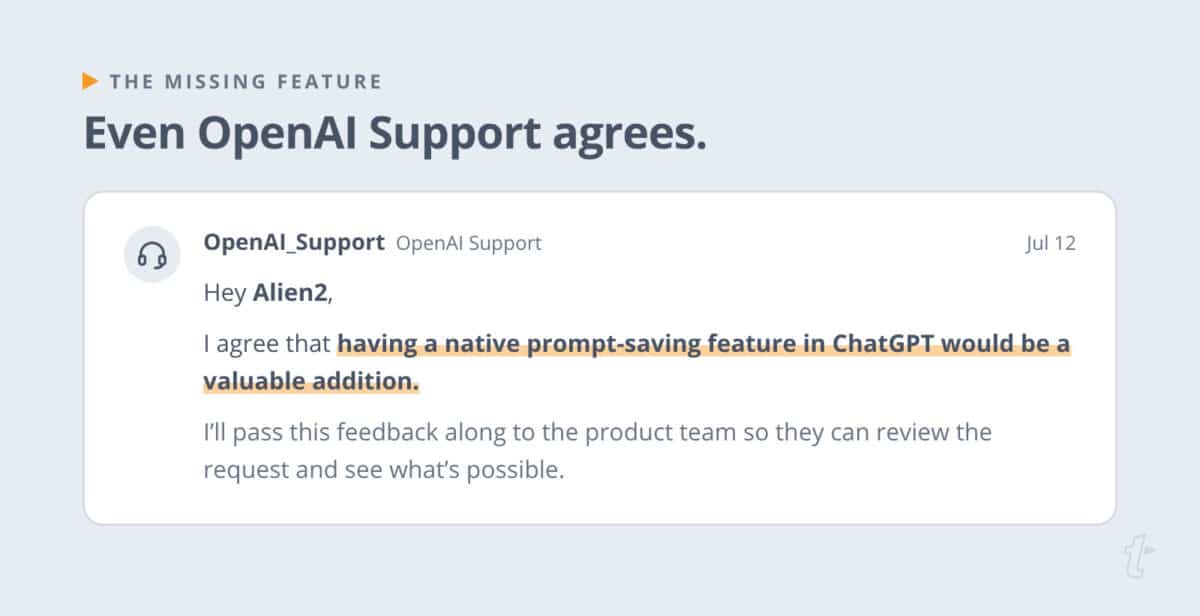
The gap is familiar to OpenAI, too. In a July 12, 2026 reply on the OpenAI Community forum, OpenAI Support said a native prompt-saving feature “would be a valuable addition.”
Custom instructions: preferences you want in every chat
Custom instructions are account-wide preferences that shape every conversation: your role, how you like answers formatted, and what to leave out. OpenAI allows up to 1,500 characters on the Free and Go plans, and up to 5,000 on the Plus, Pro, Business, Enterprise, and Edu plans.
Because they apply everywhere, they can’t hold a menu of task prompts you choose between. A prompt for summarizing customer calls would sit in the background of every chat, including the one about your budget spreadsheet.
Projects: context for one body of work
OpenAI says, “Projects keep related chats, files, and instructions together.” Project instructions apply only inside that project and take priority over your custom instructions. That makes a Project a good fit for a client account or a recurring report.
It’s a weaker fit for a prompt you use in five places, because you’d paste it into five Projects and keep five copies up to date by hand.
Skills: repeatable workflows
Skills are the closest ChatGPT comes to a saved prompt. OpenAI describes them as “reusable, shareable workflows” that bundle instructions, examples, and resources, and says ChatGPT “can automatically use” them when a task fits.
Personal Skills are available to eligible users in Business, Enterprise, Healthcare, and Education.
The difference that matters is who decides. ChatGPT chooses when a skill applies. With a saved prompt, you can choose the exact words when you need them. Both are useful for different moments.
Custom GPTs retire on December 11, 2026
If you built a custom GPT mostly to hold one good prompt, it now has a retirement date. OpenAI’s help center states, “Custom GPTs are scheduled to retire on Dec 11, 2026.” Enterprise workspaces with an approved deferral have until February 11, 2027.
OpenAI is moving each GPT’s instructions into a skill inside a plugin, so the wording carries over. Much of what was built around it doesn’t. “GPT custom actions do not transfer,” and the selected model, drafts, and sharing settings stay behind, too.
The words survive the move. The setup around them is rebuilt or lost.
Why memory isn’t a prompt library
Memory keeps details you ask ChatGPT to remember, and it can draw on past chats. OpenAI notes that chat history reference “doesn’t remember every detail.”
That’s a reasonable tradeoff for background context. For a prompt, approximate recall defeats the purpose, because the exact wording is what makes the prompt work.
| Option | What it stores | Best for | Works outside ChatGPT | Word-for-word reuse | Plans |
| Custom instructions | Context | Preferences you want in every chat | No | No. Applies to every chat | All plans (1,500 or 5,000 characters) |
| Projects | Context | One client, report, or body of work | No | Only inside one project | All signed-in users |
| Skills | Workflow | Repeatable multi-step tasks | Some OpenAI products, such as Codex | ChatGPT decides when to apply it | Personal Skills: eligible for Business, Enterprise, Healthcare, and Education |
| Custom GPTs | Workflow and context | Packaged assistants for one task | No | Until retirement | Retire December 11, 2026 (February 11, 2027, with approved Enterprise deferral) |
| Memory | Context | Personal details and preferences | No | No. Not stored verbatim | Varies by plan, region, and workspace |
Read down the “What it stores” column, and a pattern appears. Every built-in option holds context, a workflow, or both. None of them holds the plain words you type to start a task, and that’s the layer most people mean when they say “saved prompt.”

The prompt stack: context, workflows, and the words you type
Saving prompts still feels unsolved because “prompt” covers three different things. ChatGPT’s built-in features handle two of them well.
Every prompt you send is a stack of three layers:
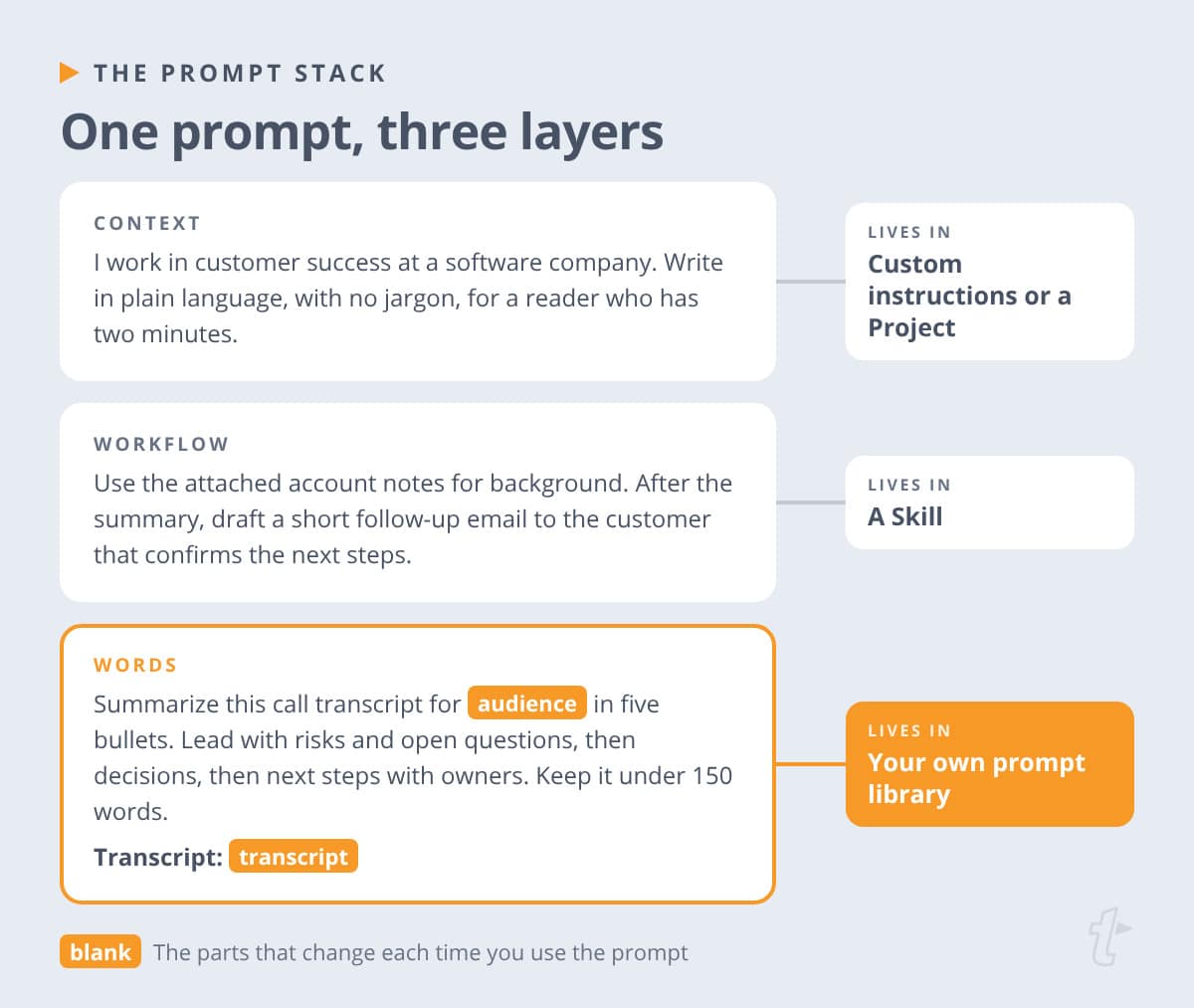
- Context: who you are, who you’re writing for, and how you like answers. Custom instructions and Projects hold this layer.
- Workflow: the steps the AI should follow, the shape of the output, and the files or tools it should use. Skills hold this layer, as do custom GPTs (at least until December 11).
- Words: the exact sentence you type to start a task. ChatGPT has no library for this layer.
One prompt, three layers
Take a prompt that plenty of people run every week: summarizing a customer call. Written out in full, it carries all three layers:
Context: I work in customer success at a software company. Write in plain language, with no jargon, for a reader who has two minutes.
Workflow: Use the attached account notes for background. After the summary, draft a short follow-up email to the customer that confirms the next steps.
Words: Summarize this call transcript for {audience} in five bullets. Lead with risks and open questions, then decisions, then next steps with owners. Keep it under 150 words.
Transcript: {transcript}
Pull it apart, and the layers separate cleanly. The context line is true of almost every chat you have, so it fits custom instructions or a Project. The workflow line is a repeatable process with steps, which is what Skills are for. The words line is the part you refined, and it’s the one you’ll reach for again.
Where each layer belongs
Native features are built to keep context and workflows within a single product. That’s reasonable. Your preferences and processes depend on how a specific AI tool behaves, and they work best when the tool can apply them automatically.
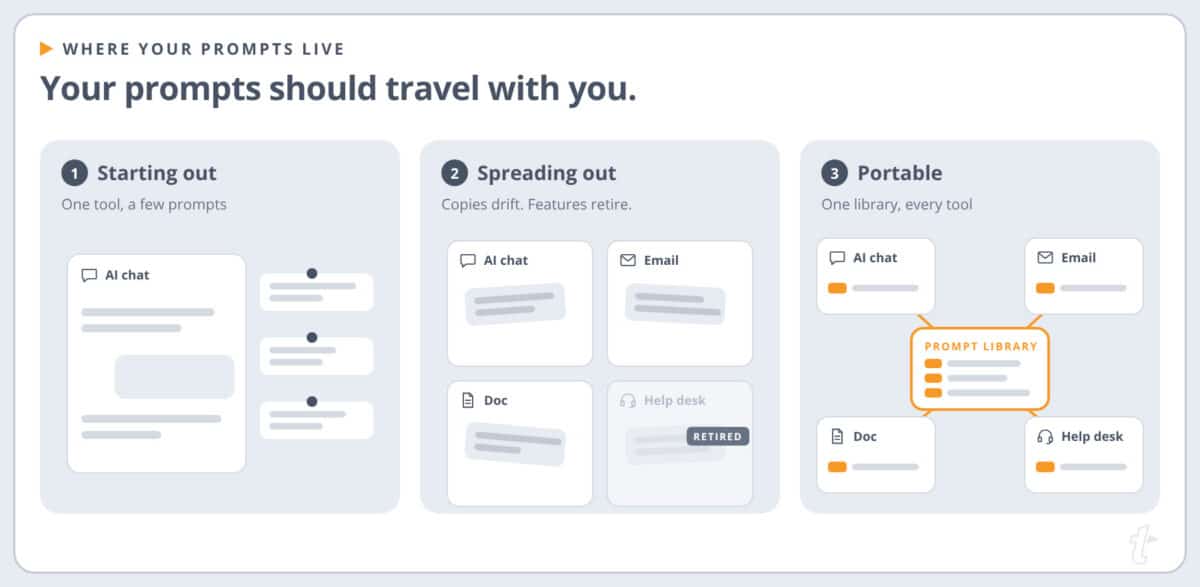
The words layer is different. It belongs to you, it improves every time you refine it, and you’ll want it in whatever tool you use next week. It’s the most portable part of your AI work, and right now it’s the least protected.
Once you separate the layers, the decision gets simple. Keep context and workflows in the AI tool. Keep the words somewhere you control.
Why your best ChatGPT prompts shouldn’t live inside one AI tool
ChatGPT is rarely the only place people type prompts anymore. In Gallup’s July 2026 workforce survey, 52% of U.S. workers said they use AI in their role, and writing and editing were the most common uses.
That writing happens across the entire workday, on multiple platforms. People now type prompts into Gemini in Gmail, Copilot in Word, and the AI fields built into help desks and CRMs. If you want to reuse prompts across those other AI tools, a prompt that only lives in ChatGPT has to be copied out every time.

AI platforms change on their own schedule
OpenAI isn’t the only one reorganizing. Google is making a similar change: “Starting in November 2026, Gems will go away on personal Google accounts and automatically transition to skills.“
Neither move is unusual. AI products reorganize their features as they grow. Your tested prompts shouldn’t have to be rebuilt every time a roadmap changes.
Microsoft 365 Copilot is the exception worth knowing
Microsoft 365 Copilot has a real save feature. After a prompt runs, you can select Save prompt, and it appears under Your saved prompts in Copilot Prompt Lab, where it is visible only to you. That works for one person, but a team can’t share one approved version.
If most of your AI work happens in Microsoft 365 Copilot, use it. Those saved prompts stay inside Microsoft 365, though, so it’s the same limit in a different place.

A Google Doc or Chrome extension solves half the problem
The most common workarounds keep your prompts outside any one AI tool, which is the right instinct. A Google Doc of favorite prompts is free, easy to start, and easy to search. A Notion database goes a step further, letting you tag and filter prompts by category.
The cost shows up in use. You open a new tab, search for the prompt, copy it, switch back, paste it, and then edit the parts that change. TextExpander customer Vienna Castellaw described her version of this habit to our support team: “massive notepad files I’d be copying and pasting from.”
Browser extensions cut out some of that switching, and most fall into one of two camps.
A ChatGPT prompt saver adds an extension icon to your browser’s toolbar and a prompt library inside the chat window. AI Toolbox, which says it has more than 40,000 users on the Chrome Web Store, opens its library when you type “//” in the ChatGPT message box. Its paid plan adds subfolders for organizing custom prompts.
A clipboard manager casts a wider net. Clipboard History Pro, with 100,000 users on its Chrome Web Store listing, automatically saves everything you copy. Your best prompts are in there, along with every link, address, and half-finished sentence you copied that week, so finding them again becomes a search problem of its own.
Both are useful inside Chrome, and that’s also their limit. A prompt saved in the browser usually isn’t there when you’re writing in a desktop app, an email draft, or a help desk reply. For a side-by-side look at the options, see our comparison of tools that manage prompts for teams.
When ChatGPT on its own is enough
If ChatGPT is the only AI tool you use and you rely on three or four prompts, a pinned chat, or custom instructions may be all you need. The case for keeping prompts somewhere portable gets stronger with every new AI tool you use, every prompt you add, and every feature change you have to work around.
How to save ChatGPT prompts as Snippets, step by step
A Snippet is a saved text plus a short abbreviation that expands it. Save a prompt as a Snippet, and typing a few characters in a chat box drops the full prompt in, ready to send.
TextExpander works on Mac, Windows, Chrome, iPhone, and iPad, and anywhere you can type on those devices. Install TextExpander, and the same prompts follow you from ChatGPT to an AI-assisted email draft to a help desk reply.
Step 1: Pick your five most-used prompts
Start with five. That’s how many active Snippets the TextExpander Free plan includes, and it’s enough to cover the prompts you reach for most.
Step 2: Give each prompt a Snippet and a short abbreviation
In the TextExpander app, choose New Snippet, paste your prompt into the Snippet editor, and type a short code in the Abbreviation field. Add a label, too, so you can tell your prompts apart later.
Pick abbreviations you won’t type by accident. A shared prefix makes them easy to remember, and a dedicated Snippet group acts like a folder, keeping your prompts organized. Start every prompt with something like ;p (for prompt) and add a short verb, such as ;psum for summaries and ;preply for email replies.
Step 3: Customize the parts that change with Fill-ins
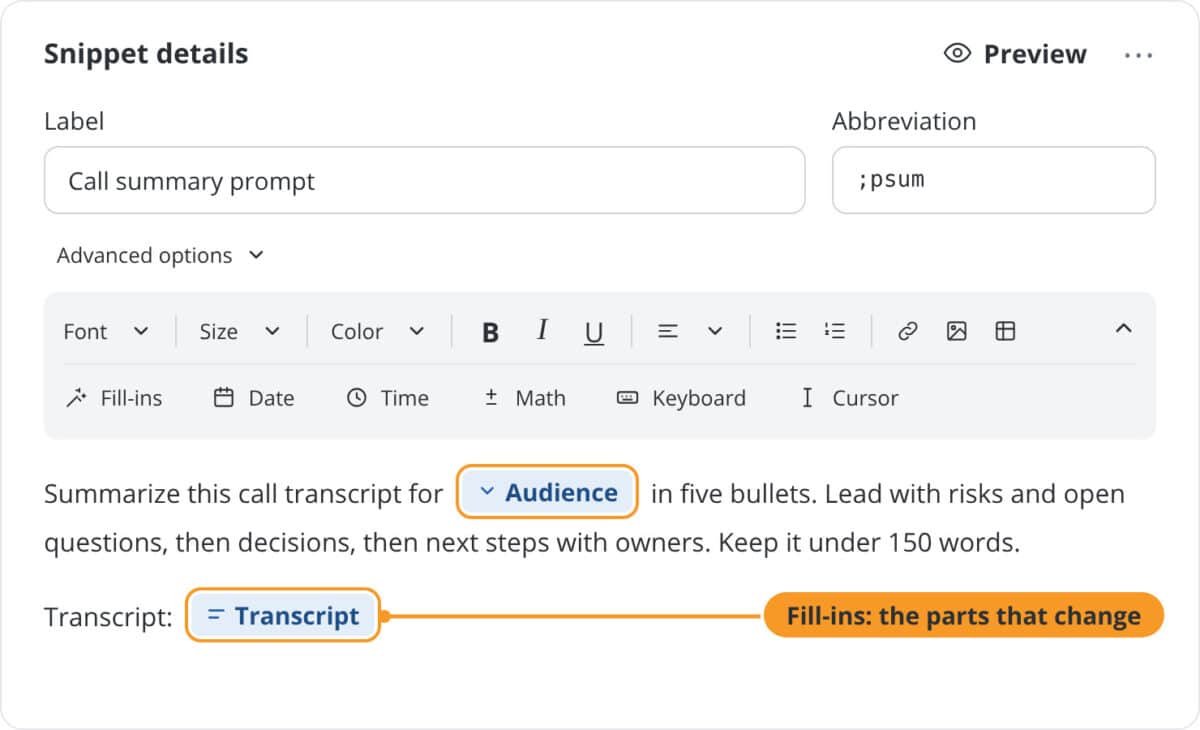
Fill-ins are blanks that TextExpander asks you to complete when a Snippet expands. Add them from the Fill-ins menu at the top of the Snippet editor. For example, a call summary prompt needs two:
- Audience as a drop-down menu (VP, customer, or my team), so you pick an option instead of typing one.
- Transcript as a single-line field, where you paste the URL for the source text, such as a transcript doc. Alternatively, use a multi-line field to paste the entire transcript.
Fill-ins also keep the rest of the prompt from drifting. Retype a prompt from memory, and the wording shifts a little each time: “five bullets” becomes “a few bullets,” and “lead with risks” quietly disappears. In the call summary example, only the audience and the transcript change. Your own prompts might use Fill-ins for tone, length, or a date. Everything else stays word-for-word, so the results are easier to predict.
Step 4: Find prompts without remembering abbreviations
Once your library grows past a handful of prompts, you won’t remember every abbreviation. Inline Search lets you search your prompt library and insert the one you need without leaving the chat box.
TextExpander solves the frustrating problem of repetitive AI prompt input. Instead of constantly retyping or copying and pasting the same prompts throughout the day, TextExpander makes them instantly accessible through shortcuts.
Koji Noguchi, Attorney at Law, OFS Fitel, LLC
Save your first five prompts free, and see more ways to keep your AI prompts a shortcut away.
Which custom prompts are worth saving
The five prompts in the widget above have something in common. Each one handles a job that comes back every week in roughly the same shape. That’s the pattern to look for.
Save prompts that carry decisions. A great prompt holds choices you’ve already made: the format, the order of information, the length, and what to leave out. Saving it means you make those choices once, not every time you open a chat.
Good candidates pass three tests:
- You’ve used the prompt at least three times
- The output is reliably good
- You can name the parts that change from one use to the next
Skip prompts where variety is the point. Creative prompts for brainstorming, naming, or new campaign angles usually work better when written fresh. A prompt you used once during a late-night brainstorming session probably doesn’t need a Snippet. In fact, when you want creative ideas, a fixed prompt could work against you.
Treat saved prompts as drafts that keep improving. When a prompt misses, test a change. If the new version works better, update the Snippet once, and every expansion after that uses it.
For more starting points, browse these AI prompt templates for work.
Keep checking the output
A saved prompt makes the request consistent. It doesn’t make the answer correct. In a 2025 global study by the University of Melbourne with KPMG, 66% of employees surveyed said they rely on AI output without evaluating its accuracy.
A tested prompt narrows the range of possible responses, making problems easier to spot. You still need to read the output before you send it.

How teams reuse prompts from a shared prompt library
Your most valuable prompts rarely stay personal for long. The signal is usually a teammate asking, “What prompt did you use for that?”
Pasting it into a chat message works once. Then everyone keeps a separate copy, someone changes theirs, and three versions of the same prompt start to drift apart.
TextExpander’s shared Team Libraries let you create prompts that everyone on your team can access. Group them by job, such as customer calls, sales follow-ups, or hiring, so new teammates can discover the pre-built prompts the team already trusts and quickly access them wherever they type.
Permissions keep a shared library easy to maintain. Editors can change a shared prompt, and everyone else can use it. When an editor improves a prompt, they update it once, and the whole team gets the new version the next time they expand it.
The same pattern already works for teams outside AI. A lead recruiter at a fast-growing HR platform put the cross-app benefit simply: “TextExpander follows me everywhere I work.”
For a full setup guide, see how to build an AI prompt library for your team.
Keep the words that work
The call summary prompt in this post is a good test case. Saved once as a Snippet, it works in ChatGPT today, in whichever tool has the transcript open tomorrow, and after December 11, when custom GPTs retire.
AI tools change on their own schedules. Features launch, move, and retire. The wording that gets you good results is the part that belongs to you, and keeping it portable means you never have to rebuild it from memory.
Start with the five prompts you use most. Save them as Snippets, and the next time you need one in a chat, an email, or a help desk reply, it’s at your fingertips. That’s how you save time: you stop rewriting prompts from memory.
Try TextExpander free, and save your five best prompts today.
Frequently asked questions
What happens to custom GPT instructions after December 11, 2026?
Custom GPTs retire on December 11, 2026, and OpenAI is moving each GPT's instructions into a skill inside a plugin. Enterprise workspaces with an approved deferral have until February 11, 2027. The instructions carry over, but custom actions, the selected model, drafts, and sharing settings do not. Before the retirement date, open each GPT you rely on, copy prompts and instructions you still use into a document or prompt library you control, and keep track of which actions you'll need to rebuild.
With the wording saved outside ChatGPT, it's ready, whether you rebuild the GPT as a skill or move the task to another AI tool.
Can custom GPT conversation starters work as saved prompts?
Only inside one GPT. Conversation starters are the example prompts a custom GPT shows when someone opens it, and OpenAI suggests including "a few realistic, high-value prompts" that reflect what the GPT is for. They make a GPT's interface easier to start with, but they're pre-built examples tied to that one GPT, so you can't manage prompts across your other tools with them.
OpenAI's migration FAQ doesn't list conversation starters among the parts that move to a skill when custom GPTs retire on December 11, 2026. If you rely on a GPT's conversation starters, copy them out before the retirement date and keep them with your other saved prompts so everything stays organized in one place.
Are Google Gemini Gems going away, too?
Yes. Google says that starting in November 2026, Gems will be removed from personal Google accounts and automatically transition to skills. The change follows the same pattern as the custom GPT retirement in ChatGPT: AI platforms are turning saved assistants into skills that the AI applies when a task fits.
If you use Gems on a personal account, copy the instructions behind the Gems you rely on before November, then check how each one behaves after it becomes a skill. Prompts you keep outside Gemini aren't affected by the change.
Do saved prompts work in the ChatGPT desktop app?
Yes, with a caveat about where the prompt is saved. ChatGPT's built-in options, such as custom instructions and Projects, are tied to your account, so they apply in the desktop app and on the web. Prompts saved in a browser extension usually stay in the browser and won't appear in the desktop app.
Prompts saved as TextExpander Snippets need the TextExpander app on Mac or Windows; after installation, Snippets expand in the desktop app's message box the same way they do in a browser. For setup tips, see how to use ChatGPT with TextExpander.
Is it safe to save prompts that include customer data?
The safest approach is to keep customer data out of the saved prompt itself. A reusable prompt should hold the instructions, such as format, tone, and length, while customer details are added only at the moment of use, through a blank you fill in or a transcript you paste. That keeps names, account numbers, and other personal data out of your prompt library and out of shared team copies.
Before pasting customer information into any AI tool, check your company's AI policy and which tools are approved for that data. In healthcare, protected health information (PHI) belongs only in tools your organization has approved under a business associate agreement (BAA).
Can ChatGPT help you write a prompt worth saving?
Yes. Open a new chat and ask ChatGPT to act as a prompt engineer for one task you repeat. Describe the job, who the output is for, and what a good result looks like, then ask it to interview you with a few questions before it writes anything. When it has enough detail, ask for a reusable prompt with the parts that change marked in curly braces, such as {audience} or {transcript}.
Test the draft on two or three real examples and adjust the wording until the output is reliably good. Then paste the prompt into a TextExpander Snippet and turn each placeholder into a Fill-in. ChatGPT drafts the first version, and the Snippet keeps the tested one a few keystrokes away.
What's the best AI prompt manager for reusing prompts across tools?
The best AI prompt manager for reusing prompts across tools is one that stores prompts outside any single AI product and works in every app you type in. When you research options, look for four things: exact wording inserted without copying and pasting, blanks for the parts that change, a search that still works as the library grows, and shared libraries so a team uses the same approved prompts. A document or note app works for a short list.
TextExpander is designed for the larger version: prompts saved as Snippets expand in ChatGPT, Claude, Gemini, Copilot, email, and help desk tools, and teams can share pre-built prompts in Team Libraries. See how to keep AI prompts a shortcut away.