

Chiropractic ICD 10 codes are used to record diagnoses, symptoms, and procedures, which is crucial for billing and reimbursements. ICD 10 (short for International Classification of Diseases, Tenth Revision) codes create a common language for medical professionals, ensuring clear communication and consistency of care between providers.
On this page, we have recorded many of the most common chiropractic ICD 10 codes for quick reference. However, with TextExpander, you’ll never have to type out or copy and paste a chiropractic ICD 10 code again. You can type a short abbreviation that expands into the properly formatted code, along with the description. Try it out now:
You can customize the abbreviation to whatever you want. Instead of m545 for “Low back pain,” you could set the abbreviation to lbp or lowbackpain.
Use TextExpander’s Inline Search feature to look up and insert ICD-10 codes. Bring up Inline Search in any app, search for a term like “low back pain” and automatically insert it into any app.
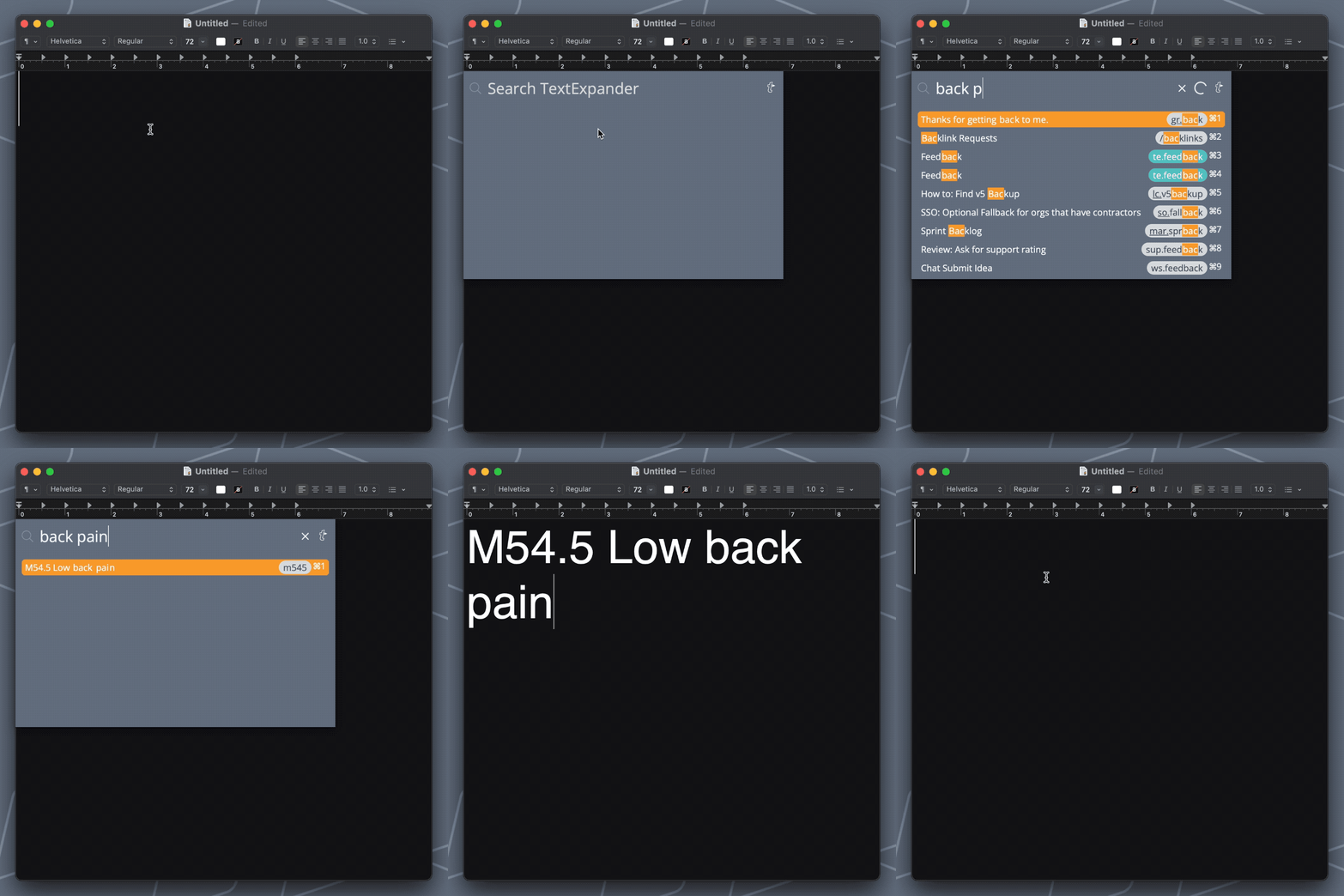
Getting started is easy:
- Create your free TextExpander account. TextExpander is available for Windows, Mac, and Google Chrome.
- Install the Chiropractic ICD-10 Codes group.
That Snippet group will get you started, but you can use TextExpander to create any Snippet you want. Use it to create Snippets for patient note templates, custom ICD-19 codes, CPT codes, or any bit of text you need. Spend less time doing paperwork and more time adjusting patients.
Not able to play the video? Click here to watch the video
Best of all, you can share your TextExpander Snippets with your entire team for consistent coding and patient notes. Mission Veterinary Partners trusts TextExpander for its 330+ hospitals. And TextExpander protects your data with extensive security and privacy policies.
Not able to play the video? Click here to watch the video
Key takeaways
- Chiropractic ICD-10 codes document why care was needed. They record diagnoses and symptoms such as cervicalgia, sciatica, spinal stenosis, and sprains, which supports billing, reimbursement, and clear communication between providers.
- Subluxation codes anchor Medicare chiropractic claims. The M99.0 codes describe segmental and somatic dysfunction by region, and Medicare expects the subluxation as the primary diagnosis, with the condition being treated listed second.
- Many codes need side or region details. Codes like M54.31 and M54.32 specify the right or left side for sciatica, and M48.06 specifies the lumbar region for spinal stenosis, so documentation should state both.
- Snippets keep coding consistent across the team. TextExpander inserts formatted codes and descriptions from a short abbreviation or Inline Search in any app, and a shared Snippet group gives every provider and biller the same codes.
Common Chiropractic ICD 10 Codes
| G43.001 Migraine without aura, not intractable, with status migrainosus |
| G43.009 Migraine without aura, not intractable, without status migrainosus |
| G43.011 Migraine without aura, intractable, with status migrainosus |
| G43.019 Migraine without aura, intractable, without status migrainosus |
| G43.101 Migraine with aura, not intractable, with status migrainosus |
| G43.109 Migraine with aura, not intractable, without status migrainosus |
| G43.111 Migraine with aura, intractable, with status migrainosus |
| G43.119 Migraine with aura, intractable, without status migrainosus |
| G44.201 Tension-type headache, unspecified, intractable |
| G44.209 Tension-type headache, unspecified, not intractable |
| G54.0 Brachial plexus disorders |
| G56.01 Carpal tunnel syndrome, right upper limb |
| G56.02 Carpal tunnel syndrome, left upper limb |
| G56.03 Carpal tunnel syndrome, bilateral upper limbs |
| G56.13 Other lesions of median nerve, bilateral upper limbs |
| G56.23 Lesion of ulnar nerve, bilateral upper limbs |
| G56.33 Lesion of radial nerve, bilateral upper limbs |
| G57.61 Lesion of plantar nerve, right lower limb |
| G57.62 Lesion of plantar nerve, left lower limb |
| M25.511 Pain in right shoulder |
| M25.512 Pain in left shoulder |
| M25.519 Pain in unspecified shoulder |
| M25.521 Pain in right elbow |
| M25.522 Pain in left elbow |
| M25.529 Pain in unspecified elbow |
| M25.531 Pain in right wrist |
| M25.532 Pain in left wrist |
| M25.539 Pain in unspecified wrist |
| M25.541 Pain in joints of right hand |
| M25.542 Pain in joints of left hand |
| M25.549 Pain in joints of unspecified hand |
| M25.551 Pain in right hip |
| M25.552 Pain in left hip |
| M25.559 Pain in unspecified hip |
| M25.561 Pain in right knee |
| M25.562 Pain in left knee |
| M25.569 Pain in unspecified knee |
| M25.571 Pain in right ankle and joints of right foot |
| M25.572 Pain in left ankle and joints of left foot |
| M25.573 Pain in ankle and joints of foot, unspecified |
| M25.579 Pain in unspecified ankle and joints of unspecified foot |
| M25.581 Pain in right thigh |
| M25.582 Pain in left thigh |
| M25.589 Pain in unspecified thigh |
| M25.591 Pain in right leg |
| M25.592 Pain in left leg |
| M25.599 Pain in unspecified leg |
| M25.601 Pain in right arm |
| M25.602 Pain in left arm |
| M25.609 Pain in unspecified arm |
| M25.611 Pain in right upper arm |
| M25.612 Pain in left upper arm |
| M25.619 Pain in unspecified upper arm |
| M25.621 Pain in right forearm |
| M25.622 Pain in left forearm |
| M25.629 Pain in unspecified forearm |
| M25.631 Pain in right wrist |
| M25.632 Pain in left wrist |
| M25.639 Pain in unspecified wrist |
| M25.641 Pain in right hand |
| M25.642 Pain in left hand |
| M25.649 Pain in unspecified hand |
| M25.651 Pain in right finger(s) |
| M25.652 Pain in left finger(s) |
| M25.659 Pain in unspecified finger(s) |
| M25.661 Pain in right thigh |
| M25.662 Pain in left thigh |
| M25.669 Pain in unspecified thigh |
| M25.671 Pain in right lower leg |
| M25.672 Pain in left lower leg |
| M25.679 Pain in unspecified lower leg |
| M25.681 Pain in right ankle |
| M25.682 Pain in left ankle |
| M25.689 Pain in unspecified ankle |
| M25.691 Pain in right foot |
| M25.692 Pain in left foot |
| M25.699 Pain in unspecified foot |
| M25.701 Pain in right toe(s) |
| M25.702 Pain in left toe(s) |
| M25.709 Pain in unspecified toe(s) |
| M25.711 Pain in right shoulder |
| M25.712 Pain in left shoulder |
| M25.719 Pain in unspecified shoulder |
| M25.721 Pain in right upper arm |
| M25.722 Pain in left upper arm |
| M25.729 Pain in unspecified upper arm |
| M25.731 Pain in right forearm |
| M25.732 Pain in left forearm |
| M25.739 Pain in unspecified forearm |
| M25.741 Pain in right hand |
| M25.742 Pain in left hand |
| M25.749 Pain in unspecified hand |
| M25.751 Pain in right thigh |
| M25.752 Pain in left thigh |
| M25.759 Pain in unspecified thigh |
| M25.761 Pain in right lower leg |
| M25.762 Pain in left lower leg |
| M25.769 Pain in unspecified lower leg |
| M25.771 Pain in right ankle |
| M25.772 Pain in left ankle |
| M25.779 Pain in unspecified ankle |
| M25.781 Pain in right foot |
| M25.782 Pain in left foot |
| M25.789 Pain in unspecified foot |
| M25.791 Pain in right toe(s) |
| M25.792 Pain in left toe(s) |
| M25.799 Pain in unspecified toe(s) |
| M41.112 Juvenile idiopathic scoliosis, cervical region |
| M41.113 Juvenile idiopathic scoliosis, cervicothoracic region |
| M41.114 Juvenile idiopathic scoliosis, thoracic region |
| M41.115 Juvenile idiopathic scoliosis, thoracolumbar region |
| M41.116 Juvenile idiopathic scoliosis, lumbar region |
| M41.117 Juvenile idiopathic scoliosis, lumbosacral region |
| M41.122 Adolescent idiopathic scoliosis, cervical region |
| M41.123 Adolescent idiopathic scoliosis, cervicothoracic region |
| M41.124 Adolescent idiopathic scoliosis, thoracic region |
| M41.125 Adolescent idiopathic scoliosis, thoracolumbar region |
| M41.126 Adolescent idiopathic scoliosis, lumbar region |
| M41.127 Adolescent idiopathic scoliosis, lumbosacral region |
| M41.41 Neuromuscular scoliosis, occipito-atlanto-axial region |
| M41.42 Neuromuscular scoliosis, cervical region |
| M41.43 Neuromuscular scoliosis, cervicothoracic region |
| M41.44 Neuromuscular scoliosis, thoracic region |
| M41.45 Neuromuscular scoliosis, thoracolumbar region |
| M41.46 Neuromuscular scoliosis, lumbar region |
| M41.47 Neuromuscular scoliosis, lumbosacral region |
| M43.6 Torticollis |
| M47.811 Spondylosis without myelopathy or radiculopathy, occipito-atlanto-axial region |
| M47.812 Spondylosis without myelopathy or radiculopathy, cervical region |
| M47.813 Spondylosis without myelopathy or radiculopathy, cervicothoracic region |
| M47.816 Spondylosis without myelopathy or radiculopathy, lumbar region |
| M47.817 Spondylosis without myelopathy or radiculopathy, lumbosacral region |
| M48.01 Spinal stenosis, occipito-atlanto-axial region |
| M48.02 Spinal stenosis, cervical region |
| M48.03 Spinal stenosis, cervicothoracic region |
| M48.06 Spinal stenosis, lumbar region |
| M48.07 Spinal stenosis, lumbosacral region |
| M50.020 Cervical disc disorder with myelopathy, mid-cervical region, unspecified level |
| M50.021 Cervical disc disorder at C4-C5 level with myelopathy |
| M50.022 Cervical disc disorder at C5-C6 level with myelopathy |
| M50.023 Cervical disc disorder at C6-C7 level with myelopathy |
| M50.11 Cervical disc disorder with radiculopathy, occipito-atlanto-axial region |
| M50.12 Cervical disc disorder with radiculopathy, mid-cervical region |
| M50.121 Cervical disc disorder at C4-C5 level with radiculopathy |
| M50.122 Cervical disc disorder at C5-C6 level with radiculopathy |
| M50.123 Cervical disc disorder at C6-C7 level with radiculopathy |
| M50.13 Cervical disc disorder with radiculopathy, cervicothoracic region |
| M50.220 Other cervical disc displacement, mid-cervical region, unspecified level |
| M50.221 Other cervical disc displacement at C4-C5 level |
| M50.222 Other cervical disc displacement at C5-C6 level |
| M50.223 Other cervical disc displacement at C6-C7 level |
| M50.31 Other cervical disc degeneration, occipito-atlanto-axial region |
| M50.32 Other cervical disc degeneration, mid-cervical region |
| M50.321 Other cervical disc degeneration at C4-C5 level |
| M50.322 Other cervical disc degeneration at C5-C6 level |
| M50.323 Other cervical disc degeneration at C6-C7 level |
| M50.33 Other cervical disc degeneration, cervicothoracic region |
| M50.821 Other cervical disc disorders at C4-C5 level |
| M50.822 Other cervical disc disorders at C5-C6 level |
| M50.823 Other cervical disc disorders at C6-C7 level |
| M51.14 Intervertebral disc disorders with radiculopathy, thoracic region |
| M51.15 Intervertebral disc disorders with radiculopathy, thoracolumbar region |
| M51.16 Intervertebral disc disorders with radiculopathy, lumbar region |
| M51.17 Intervertebral disc disorders with radiculopathy, lumbosacral region |
| M51.36 Other intervertebral disc degeneration, lumbar region |
| M51.37 Other intervertebral disc degeneration, lumbosacral region |
| M53.3 Sacrococcygeal disorders, not elsewhere classified |
| M53.81 Other specified dorsopathies, occipito-atlanto-axial region |
| M53.82 Other specified dorsopathies, cervical region |
| M53.83 Other specified dorsopathies, cervicothoracic region |
| M53.84 Other specified dorsopathies, thoracic region |
| M53.85 Other specified dorsopathies, thoracolumbar region |
| M53.86 Other specified dorsopathies, lumbar region |
| M54.11 Radiculopathy, occipito-atlanto-axial region |
| M54.12 Radiculopathy, cervical region |
| M54.13 Cervicobrachial syndrome |
| M54.16 Radiculopathy, lumbar region |
| M54.17 Radiculopathy, lumbosacral region |
| M54.2 Cervicalgia |
| M54.31 Sciatica, right side |
| M54.32 Sciatica, left side |
| M54.41 Lumbago with sciatica, right side |
| M54.42 Lumbago with sciatica, left side |
| M54.5 Low back pain |
| M54.6 Pain in thoracic spine |
| M75.01 Adhesive capsulitis of right shoulder |
| M75.02 Adhesive capsulitis of left shoulder |
| M75.51 Bursitis of right shoulder |
| M75.52 Bursitis of left shoulder |
| M76.51 Patellar tendinitis, right knee |
| M76.52 Patellar tendinitis, left knee |
| M77.01 Medial epicondylitis, right elbow |
| M77.02 Medial epicondylitis, left elbow |
| M77.11 Lateral epicondylitis, right elbow |
| M77.12 Lateral epicondylitis, left elbow |
| M77.31 Medial epicondylitis, right elbow |
| M77.32 Medial epicondylitis, left elbow |
| M77.41 Lateral epicondylitis, right elbow |
| M77.42 Lateral epicondylitis, left elbow |
| M79.601 Pain in right arm |
| M79.602 Pain in left arm |
| M79.603 Pain in arm, unspecified |
| M79.604 Pain in right leg |
| M79.605 Pain in left leg |
| M79.606 Pain in leg, unspecified |
| M79.609 Pain in unspecified limb |
| M79.621 Pain in right upper arm |
| M79.622 Pain in left upper arm |
| M79.623 Pain in upper arm, unspecified |
| M79.631 Pain in right forearm |
| M79.632 Pain in left forearm |
| M79.633 Pain in forearm, unspecified |
| M79.641 Pain in right hand |
| M79.642 Pain in left hand |
| M79.643 Pain in hand, unspecified |
| M79.644 Pain in right finger(s) |
| M79.645 Pain in left finger(s) |
| M79.651 Pain in right thigh |
| M79.652 Pain in left thigh |
| M79.653 Pain in thigh, unspecified |
| M79.661 Pain in right lower leg |
| M79.662 Pain in left lower leg |
| M79.663 Pain in lower leg, unspecified |
| M79.671 Pain in right foot |
| M79.672 Pain in left foot |
| M79.673 Pain in foot, unspecified |
| M79.674 Pain in right toe(s) |
| M79.675 Pain in toe(s) |
| M79.675 Pain in left toe(s) |
| M79.676 Pain in toe(s), unspecified |
| M99.01 Segmental and somatic dysfunction of cervical region |
| M99.02 Segmental and somatic dysfunction of thoracic region |
| M99.03 Segmental and somatic dysfunction of lumbar region |
| M99.04 Segmental and somatic dysfunction of sacral region |
| M99.05 Segmental and somatic dysfunction of pelvic region |
| M99.07 Segmental and somatic dysfunction of upper extremity |
| M99.08 Segmental and somatic dysfunction of rib cage |
| M99.09 Segmental and somatic dysfunction of lower extremity |
| R51 Headache |
| S13.4XXA Sprain of ligaments of cervical spine, initial encounter |
| S16.1XXA Strain of muscle, fascia and tendon at neck level, initial encounter |
| S23.3XXA Sprain of ligaments of thoracic spine, initial encounter |
| S23.41XA Sprain of ribs, initial encounter |
| S23.421A Sprain of chondrosternal joint, initial encounter |
| S33.5XXA Sprain of ligaments of lumbar spine, initial encounter |
| S33.6XXA Sprain of sacroiliac joint, initial encounter |
| S33.8XXA Sprain of other parts of lumbar spine and pelvis, initial encounter |
| S33.9XXA Sprain of unspecified parts of lumbar spine and pelvis, initial encounter |
| S39.012A Strain of muscle, fascia and tendon of lower back, initial encounter |
| S43.411A Sprain of right coracohumeral (ligament), initial encounter |
| S43.412A Sprain of left coracohumeral (ligament), initial encounter |
| S43.421A Sprain of right rotator cuff capsule, initial encounter |
| S43.422A Sprain of left rotator cuff capsule, initial encounter |
| S43.51XA Sprain of right acromioclavicular joint, initial encounter |
| S43.52XA Sprain of left acromioclavicular joint, initial encounter |
| S43.81XA Sprain of other specified parts of right shoulder girdle, initial encounter |
| S43.82XA Sprain of other specified parts of left shoulder girdle, initial encounter |
| S46.011A Strain of muscle(s) and tendon(s) of the rotator cuff of right shoulder, initial encounter |
| S46.012A Strain of muscle(s) and tendon(s) of the rotator cuff of left shoulder, initial encounter |
| S46.091A Other injury of muscle(s) and tendon(s) of the rotator cuff of right shoulder, initial encounter |
| S46.092A Other injury of muscle(s) and tendon(s) of the rotator cuff of left shoulder, initial encounter |
| S46.811A Strain of other muscles, fascia and tendons at shoulder and upper arm level, right arm, initial encounter |
| S46.812A Strain of other muscles, fascia and tendons at shoulder and upper arm level, left arm, initial encounter |
| S92.401A Fracture of unspecified phalanx of right foot, initial encounter for closed fracture |
| S92.402A Fracture of unspecified phalanx of left foot, initial encounter for closed fracture |
| S92.409A Fracture of unspecified phalanx of foot, unspecified foot, initial encounter for closed fracture |
| S93.401A Sprain of unspecified ligament of right ankle, initial encounter |
| S93.402A Sprain of unspecified ligament of left ankle, initial encounter |
| S93.409A Sprain of unspecified ligament of ankle, unspecified ankle, initial encounter |
| S93.411A Sprain of deltoid ligament of right ankle, initial encounter |
| S93.412A Sprain of deltoid ligament of left ankle, initial encounter |
| S93.421A Sprain of calcaneofibular ligament of right ankle, initial encounter |
| S93.422A Sprain of calcaneofibular ligament of left ankle, initial encounter |
| S93.431A Sprain of tibiofibular ligament of right ankle, initial encounter |
| S93.432A Sprain of tibiofibular ligament of left ankle, initial encounter |
| S93.491A Sprain of other ligament of right ankle, initial encounter |
| S93.492A Sprain of other ligament of left ankle, initial encounter |
| S93.601A Strain of muscle, fascia and tendon of peroneal muscle group at lower leg level, right leg, initial encounter |
| S93.602A Strain of muscle, fascia and tendon of peroneal muscle group at lower leg level, left leg, initial encounter |
| S93.611A Strain of muscle, fascia and tendon of extensor muscle group at lower leg level, right leg, initial encounter |
| S93.612A Strain of muscle, fascia and tendon of extensor muscle group at lower leg level, left leg, initial encounter |
How to pair subluxation codes with other diagnoses on Medicare claims
Medicare covers chiropractic manipulation only to treat a subluxation of the spine, so the claim lists the subluxation first. Report the M99.0 code for the spinal region you treated as the primary diagnosis, then the neuromusculoskeletal condition that needs treatment, such as sciatica or cervicalgia, as the secondary diagnosis.
- Primary diagnosis: The segmental and somatic dysfunction code for each region treated, for example M99.01 for cervical, M99.02 for thoracic, or M99.03 for lumbar. WPS, a Medicare contractor, lists M99.00 to M99.05 for this.
- Secondary diagnosis: The condition that explains why treatment is needed, such as M54.2 cervicalgia, M54.16 lumbar radiculopathy, or M54.31 sciatica on the right side. Each Medicare contractor publishes its own list of accepted secondary codes.
- Procedure codes: Spinal manipulation is billed with CPT 98940, 98941, or 98942, depending on how many spinal regions you treat. Medicare doesn’t cover extraspinal manipulation (CPT 98943), so the M99.07 to M99.09 codes apply to other payers’ claims.
- AT modifier: Add it to 98940 to 98942 for active or corrective treatment. Without it, Medicare treats the manipulation as maintenance care, which isn’t considered medically necessary.
Commercial payers set their own rules, so check each payer’s policy and your Medicare contractor’s billing and coding article before you rely on a pairing. Once you know the pairs you bill most, save each one as a TextExpander Snippet, such as M99.03 with M54.16, so one abbreviation enters both codes in the right order. Start with the Chiropractic ICD-10 Codes group above, and for site-specific pain codes, see our list of ICD 10 codes for pain. For visit notes, our medical dot phrases page shows how clinics share approved wording.
TextExpander is free. Your time isn’t.
Create shortcuts for the things you type most and start saving time everywhere you type. Use it solo or build a shared library with your team.
Free forever, no credit card required.
Frequently asked questions
What are M99 codes in chiropractic?
M99 codes describe biomechanical lesions. The M99.0 codes cover segmental and somatic dysfunction, which chiropractors use to report subluxation by region: M99.01 cervical, M99.02 thoracic, M99.03 lumbar, M99.04 sacral, and M99.05 pelvic. M99.07 to M99.09 cover the upper extremity, rib cage, and lower extremity. On Medicare claims, the spinal M99.0 code is the primary diagnosis.
Does Medicare require a subluxation diagnosis for chiropractic care?
Yes. Medicare covers chiropractic manual manipulation of the spine only to correct a subluxation, so the subluxation code must be the primary diagnosis, with the neuromusculoskeletal condition being treated as the secondary diagnosis. Active treatment claims also need the AT modifier, and Medicare doesn't cover extraspinal manipulation. Check your Medicare contractor's billing and coding article for its accepted codes.
How do I use the Chiropractic ICD-10 Codes Snippet group?
Install the group from the link in step 2 above, and each code becomes a Snippet you can expand with its abbreviation or find with Inline Search by typing part of the description. You can change any abbreviation to one you'll remember, such as lbp for low back pain, and share the group with your team so everyone enters the same codes.


